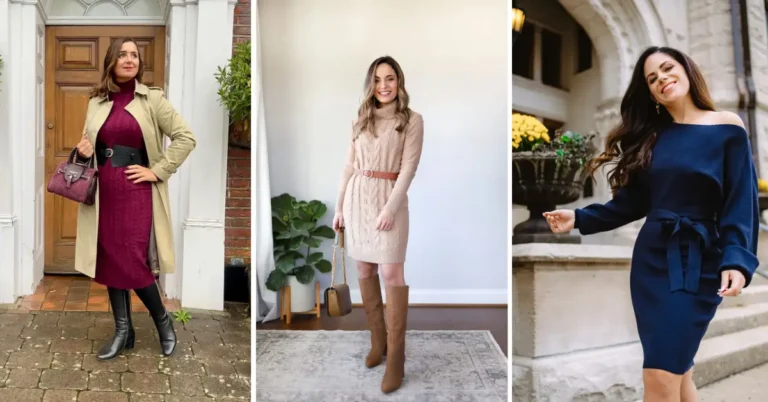
You have been buying dresses for years. But finding the best dress length for petite women is not as obvious as it sounds. If you are under 5’4″, there is a good chance the lengths you keep reaching for are working against your proportions.
A midi that looked polished on the rack makes you look four inches shorter at home. A knee-length dress hits a spot that chops your legs in half. It is not the dress. It is where the hem falls on your specific frame.
The answer is not one universal length. It shifts based on your waist placement, how your leg length compares to your torso, and what shoes you put on. Most petite women skip the measuring step entirely. They shop by name instead of by number, and they keep getting the same frustrating results.
This guide walks you through exactly how to take your measurements, map every length to your frame, and avoid the one zone that trips up nearly every petite woman shopping for midis.
Grab a flexible measuring tape and something to write on. The measuring takes under ten minutes. The results stay with you every time you shop.
Total Time
10 min
Active Time
5 min
Skill Level
Beginner
What You Need
✓Flexible measuring tape
✓A standard chair
✓Notepad or phone notes app
✓A pen or pencil
✓Full-length mirror
✓A friend to help measure
At a Glance
1
Measure your height and waist-to-floor number barefoot
2
Map every dress length category to your actual frame
3
Find your proportion type by measuring your leg ratio
4
Pick your everyday base length from your results
5
Apply the mid-calf rule before buying any midi dress
6
Read the waistline placement before you try it on
7
Plan your shoes before committing to a length
8
Run the three-point fitting room check
1. Measure your height and waist-to-floor number barefoot
Stand flat against a wall in bare feet and have someone mark the highest point of your head. Measure from the floor to that mark. Write it down. Find your natural waist by pressing two fingers into your side and bending slightly until you feel the narrowest indent.
That sits roughly one inch above your navel. Measure from there straight down to the floor while standing upright. Record that second number too. These two figures are the foundation of every hem decision in this guide.
2. Map every dress length category to your actual frame
Retailers measure from the shoulder down to the hem. That number means nothing until it maps to your body. Use your waist-to-floor figure as the anchor. Each length category sits a specific distance from the floor.
A mini leaves roughly 20 or more inches of clearance. An above-the-knee hem leaves about 14 to 20 inches. A midi, when done right, leaves between 5 and 13 inches. A maxi grazes within 2 to 4 inches of the floor. The chart below shows these zones for petite frames. Write your personal targets next to each one.
Your Petite Length Map
Floor clearance guide for frames 5’0″ to 5’4″ in flat shoes
Mini
20″+
from floor
Flattering
Above Knee
14-20″
from floor
Flattering
At Knee
11-14″
from floor
Check Fit
Midi
5-13″
from floor
Rule Applies
Maxi
2-4″
from floor
Waist First
Heels add roughly 2 to 3 inches. Adjust each floor clearance figure by that amount when planning your shoe height.
3. Find your proportion type by measuring your leg ratio
Two petite women can stand at exactly 5’2″ and dress completely differently. The difference comes down to how much of their height lives in their legs versus their torso.
That split determines which hems work in flats and which ones demand heels. Sit in a chair with feet flat on the floor. Have someone measure from the top of your head to the seat. Subtract that from your total height.
Divide the result by your total height. 45% or higher means long legs. Below 45% means a longer torso. Use the card below to read your result.
4. Pick your everyday base length from your results
Your proportion type and waist-to-floor measurement together narrow the entire dress market down to a short list. If your leg ratio came back at 45% or above and your waist-to-floor measures between 38 and 42 inches, knee-length is your most reliable daily option in flats.
Long-torso petites at the same height get more mileage from above-the-knee. Both types wear minis without restriction. The base length is the one that works in flats, without a belt, on an ordinary day. Find it once and use it every time you shop.
Match your proportion type to your usual shoe height
Proportion Type
Flats
1-2″ Heel
2-3″ Heel
Long-Legged
Ratio 45% or above
Knee or Above Knee
Midi or Knee
Midi or Maxi
Long-Torso
Ratio below 45%
Above Knee or Mini
Knee or Above Knee
Midi or Knee
Your base length is the hem that works in flats without extra effort. Use it as your starting point, not your limit.
5. Apply the mid-calf rule before buying any midi dress
The widest part of your calf is exactly where most midis fall on a petite frame. That specific point cuts the leg line in half and makes the whole silhouette read shorter.
Before buying any midi, press two fingers into the widest part of your calf and note where it sits. The hem must land either 2 to 3 inches above that mark or 2 to 3 inches below it. Nothing at the midpoint.
Heads Up
The mid-calf danger zone is not about the midi style itself. It is about where the hem lands on your specific calf. A hem 2 to 3 inches above or below the widest point will look longer and leaner than one that stops right at it. This rule applies to every midi silhouette on every petite frame, regardless of fabric or cut.
6. Read the waistline placement before you try it on
Before the dress reaches the fitting room, the waistline seam has already decided your proportions. A seam at the natural waist works when your leg and torso lengths are roughly equal. An empire seam, placed 4 to 6 inches above the natural waist, visually raises where your legs begin.
On a petite frame, that shift adds the impression of 3 to 4 inches of leg length. A dropped waist does the opposite. It lowers the skirt’s start and shortens your leg line fast. Check the seam position on the hanger before you do anything else.
Waistline Placement Guide
Petite Rating
Empire Waist
4 to 6 inches above the natural waist
Raises the visual start of the skirt. Adds the most leg length of any waistline type. Best choice for long-torso petites.
Best
High Waist
2 to 3 inches above the natural waist
Elongates the lower body. Works across both petite proportion types without restriction.
Strong
Natural Waist
At the narrowest point of the torso
Works for long-legged petites. Less effective for long-torso frames where legs appear shorter by comparison.
Neutral
Dropped Waist
At the hip or below the natural waist
Lowers the visual skirt start. Shortens the leg line on any petite frame. Avoid unless the hem is very short.
Avoid
7. Plan your shoes before committing to a length
A 2-inch heel shifts every hem on your frame by the same amount. A midi that sits in the mid-calf danger zone in flats clears it once heels are on. Decide your shoe height before you choose the dress length.
Pointed-toe styles in a shade close to your skin tone extend the leg line even in flats. Ankle straps draw a horizontal cut across the narrowest point of the ankle. Reserve them for above-the-knee lengths only.
Pro Tip
A nude pointed flat gives you the same elongating effect as a low heel without adding height. If you are shopping in flats but plan to wear the dress with a heel, try it on in both. The hem reads completely differently at each shoe height and the difference can cover two full length categories.
Shoe Strategy by Length
What to wear and what to skip at each hem
Mini and Above Knee
Wear
Any toe shape works here. Block heels, pointed flats, sandals, or sneakers. This is the most forgiving length for shoe pairing.
Skip
Chunky platform soles that add visual bulk to the foot without creating a lean line through the leg.
Midi
Most important length to get right
Wear
Pointed-toe pumps, kitten heels, or pointed flats in a skin-matching nude. Low vamp for the longest visible leg line.
Skip
Ankle straps. They create a second horizontal cut at the ankle right where the midi hem already shortens the leg line.
Maxi
Wear
A heel of at least 2 inches to keep the hem off the floor. Pointed or strappy slingbacks in a nude or tonal shade.
Skip
Flat sandals unless the dress was cut and hemmed for your exact height in bare feet.
8. Run the three-point fitting room check
The fitting room is where a good choice gets confirmed and a bad one gets caught. Once the dress is on, run three checks. Stand facing the mirror, feet together. The hem should hold a clean horizontal line.
Turn sideways and check that it stays level. Walk four or five steps toward the mirror and stop. A working length moves with you and lands back at the same point. Riding up or shifting at any check means the dress needs a different length.
Three-Point Fitting Room Check
Run all three before you pay
1
Front Check
Stand facing the mirror with feet together. The hem should sit level with no forward pull and no dipping at the back.
PASSES WHEN: The hemline holds a clean even horizontal line across the front.
2
Side Check
Turn sideways and look at the hemline in the mirror. It should stay level across both the front and back panels of the dress.
PASSES WHEN: No forward tilt and no backward drop is visible from the side.
3
Movement Check
Walk four or five steps toward the mirror and stop. Watch where the hem returns once you are standing still again.
PASSES WHEN: The hem lands back at the same point it started from without riding up.
Common Mistakes
What petite women get wrong most often
1
Shopping by length name instead of measurement
The label tells you the category. It does not tell you where the hem hits your specific frame. Two women at the same height can stand in the same dress and see completely different hemlines. Know your waist-to-floor number before you shop.
2
Buying a midi that hits the mid-calf dead zone
A hem at the widest point of the calf shortens the visual leg more than any other single sizing mistake. Moving the hem two to three inches above or below that point changes the entire look. Check this before you pay.
3
Wearing ankle straps with a midi or maxi
Ankle straps draw a horizontal line across the narrowest part of the leg. Combine that with a longer hem and you have two horizontal cuts working against the leg line at the same time. Reserve ankle straps for above-the-knee lengths.
4
Choosing a dropped waist on a long-torso frame
A dropped waist pushes the visual skirt start down to the hip. On a long-torso frame where the legs are already shorter in proportion, this makes them read even shorter. An empire or high waist on the exact same dress length reads completely differently.
Common Questions
Q
What is the best dress length for a petite woman?
Above-the-knee is the most reliable starting point for petite frames in flat shoes. It shows the most leg and requires no heel to work. Knee-length and midi are both options depending on your leg-to-torso ratio and the shoe height you plan to wear.
Q
What dresses look best on petites?
Dresses with a defined waistline at or above the natural waist work best. A-line and fit-and-flare silhouettes add shape without adding bulk. Avoid boxy cuts, dropped waists, and anything with heavy fabric that sits below the hip without structure.
Q
How long should a dress be for a 5’4″ woman?
Above-the-knee sits cleanly without heels and knee-length reads as polished in flats at this height. A midi works well with a 1 to 2 inch heel. At 5’4″ you sit at the upper end of the petite range, so there is more flexibility across length categories than at 5’0″ or 5’2″.
Q
What is the best dress length for a short girl?
The answer depends on your leg-to-torso ratio more than your height alone. Above-the-knee is the most reliable length at any short frame because it shows the most leg and reads proportionally without a heel. Once you know your ratio, you can work from there toward longer options.
Q
Can petite women wear maxi dresses?
Yes. The key is waistline placement. An empire seam or defined high waist stops the skirt from overwhelming the frame. The hem should graze the top of the foot or ankle. Anything longer needs hemming to work properly.
Q
What is the most flattering dress length for a 5’0″ frame?
Above the knee is the most reliable option in flat shoes. It shows the most leg and creates the longest visible line without any adjustments. Knee-length works too but benefits from a pointed-toe shoe to maintain the leg line.
Q
Do I need heels to wear a midi dress as a petite woman?
Not always. Long-legged petites with a ratio at or above 45% can wear certain midis in pointed-toe flats. Long-torso petites get better results with at least a 1-inch heel. The shoe matters as much as the dress at this length.
Q
How do I know if a dress is cut for petite proportions?
Check the shoulder-to-hem measurement in the size chart. Petite-sized dresses are proportioned for women 5’4″ and under. Regular sizing is built around a 5’6″ to 5’7″ reference. That difference shows up in where the hem falls and where the waist seam sits on your body.
Q
What length works best for a petite woman at a formal event?
A floor-length gown with an empire or high waist paired with a heel of at least 2 inches. For cocktail events, an above-the-knee dress in a formal fabric works well. Avoid below-the-ankle lengths in flat shoes as the hem drags and overwhelms the frame.
Quick Reference Card
Save this. Bring it every time you shop.
Petielle.com
What You Need
Flexible measuring tape
A standard chair
Notepad or phone notes
Full-length mirror
A friend to help measure
A pen or pencil
The 8 Steps
1
Measure height and waist-to-floor barefoot
2
Map each length category to your frame
3
Calculate your leg-to-torso ratio
4
Pick your everyday base length
5
Check the midi against the mid-calf rule
6
Read the waistline placement on the hanger
7
Plan shoe height before committing
8
Run the three-point fitting room check
The Rules to Remember
Midi Rule
Hem lands 2 to 3 inches above or below the widest calf point. Never at it.
Waist Rule
Empire or high waist adds leg length. Dropped waist removes it.
Shoe Rule
A 2-inch heel shifts every hem by 2 inches. Plan shoes first.
Conclusion
You now have a personal measurement, a proportion type, and a system that works in every fitting room. No more guessing by label name. No more dresses that looked right on the rack and wrong at home.