What to Wear to an Interview When You’re Petite (21 Real Outfit Ideas)

Getting dressed for an interview when you are petite comes with a specific set of frustrations. Blazers that hit too low. Trousers that swallow you whole. Skirts that look nothing like the photo once they are on your actual body. The standard advice, stick to neutrals, wear heels, avoid anything oversized, covers the basics but skips the details that actually matter on a shorter frame.
This roundup of petite interview outfits goes further than the usual checklist. You will find everything from a full cream suit held together by a single dark belt, to a tweed jacket worn over an all-black base so the jacket reads as the clear focal point. Some outfits work with heels, some work without.
Some suit conservative industries, some suit creative ones. The connecting thread across all of them is that every proportion decision, jacket length, trouser rise, shoe tone, belt placement, was made with a petite silhouette in mind.
Pick the one that fits your industry, your comfort level, and the impression you want to walk in with.
1. Navy Skirt Suit, Nude Heels, and One Vertical Line
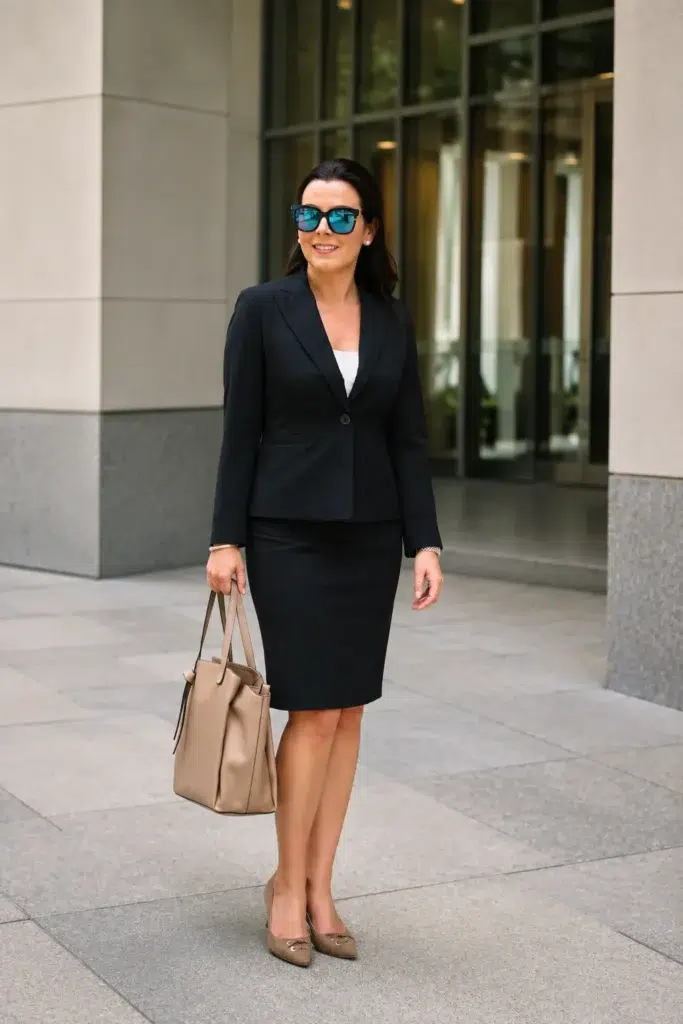
Matching sets solve one of the biggest petite interview dressing problems: the broken-up silhouette. When your top, blazer, and skirt are three different colors, the eye has nowhere clean to land. A navy suit like this one creates a single vertical line from shoulder to knee, and that reads as height before you say a word.
What makes this version work:
- The blazer is fitted and ends at the hip, not mid-thigh. That one length detail matters a lot on a petite frame.
- The pencil skirt hits at or just above the knee — formal, but still walkable.
- Nude pointed-toe flats extend the leg line past the ankle with no visual stop at the foot.
- A light top underneath draws the eye up toward the face and keeps the neckline from feeling heavy.
The tan structured tote pulls all the neutrals together cleanly. Keep jewelry minimal — small studs and one delicate bracelet are just right.
2. A Slim Dark Belt Is the Only Thing a Cream Dress Needs
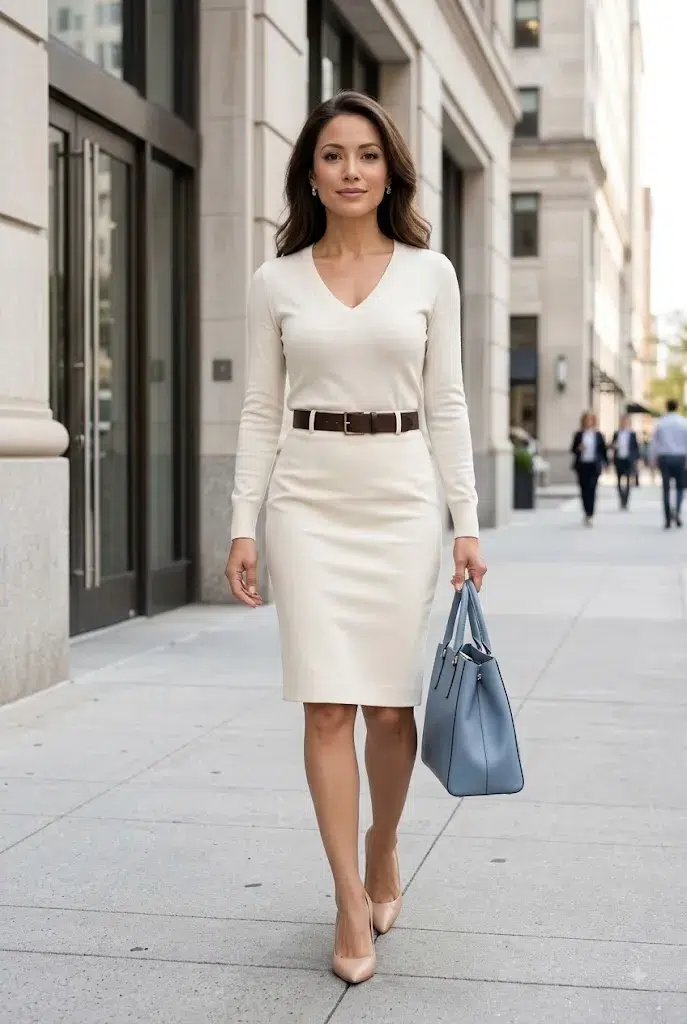
A dark brown belt on a cream dress sounds simple. Here, it is doing real work.
Without that belt, this dress would still be polished — but it would read as a pale column with no clear waist. The belt placed at the natural waist creates a defined shape, gives the monochrome look somewhere to land, and makes the whole silhouette feel intentional rather than plain. On a petite frame, a defined waist is one of the most reliable proportion tools there is.
The rest of the outfit is deliberately quiet. The v-neckline draws the eye upward and adds visual length to the neck. Nude heels melt into the dress color and keep the leg line unbroken. The dusty blue tote is the only real color in the look — just enough to prevent it from feeling flat, not enough to break the vertical line.
This outfit reads as confident and sharp without trying hard, which is usually exactly the right impression for an interview.
The cream dress reads as polished but shapeless. The eye has no clear anchor point, and the look can swallow a petite frame.
A dark narrow belt at the natural waist creates shape, defines the silhouette, and gives the monochrome look a visual anchor that reads as put-together instantly.
3. Grey and Black Together — No Matching Suit Required
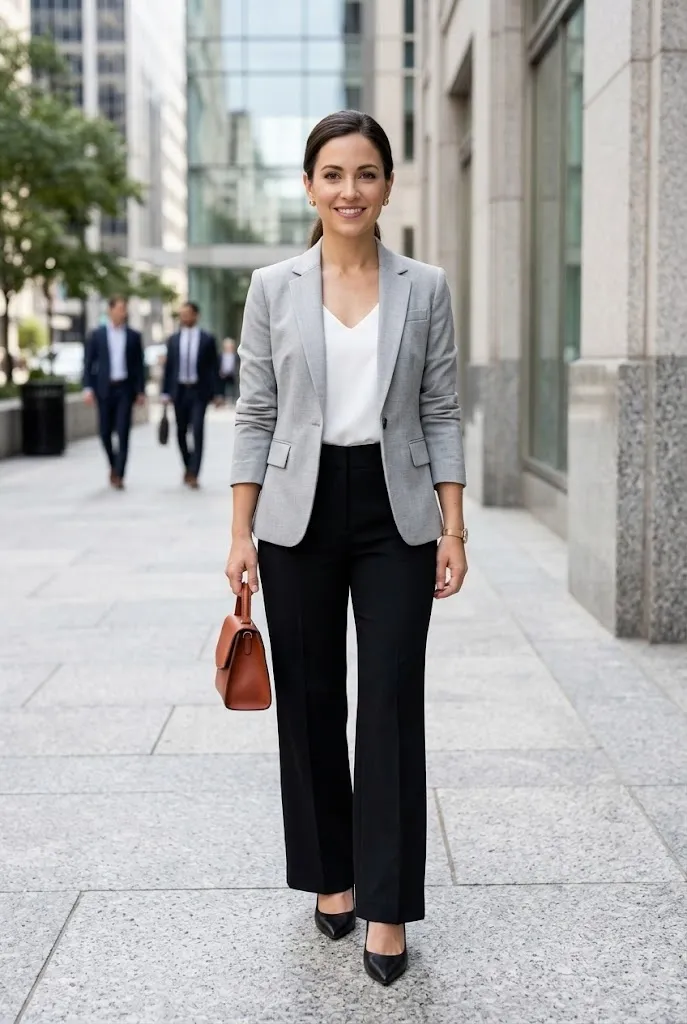
Grey and black together sounds corporate-safe to the point of boring. This outfit proves the combination just needs the right cuts and one warm accent to feel polished and modern rather than flat.
The blazer is fitted through the shoulders and hits right at the hip — that length is key for petites. Go longer and the torso disappears. The white v-neck underneath keeps the neckline open and draws the eye up toward the face instead of the middle of the outfit.
The trousers are the interesting choice here. They have a slight flare at the hem, which is usually flagged as a “avoid if you’re petite” piece — but with a pointed-toe heel that peeks below the hem, it reads as intentional and long-legged. The black-on-black shoe and trouser moment creates a seamless leg line.
The cognac structured bag is doing the warmth work in an otherwise cool palette. Without it, this outfit would feel a little stark. One rich warm tone is all it takes.
html
Choose a slight flare or wide-leg trouser when wearing a pointed heel — the hem skims the shoe and creates a long, unbroken leg line.
Keep the waist high and the blazer fitted at the hip so the top half stays defined and does not get swallowed by the trouser volume.
Cropped wide-leg trousers cut the leg at the worst point and read as too casual for most interviews — save them for the office, not the first meeting.
Flat shoes with wider-leg trousers on a petite frame push the proportions off balance. The heel is the thing holding this silhouette together.
4. Two Small Details That Stop an All-Black Outfit From Reading Heavy
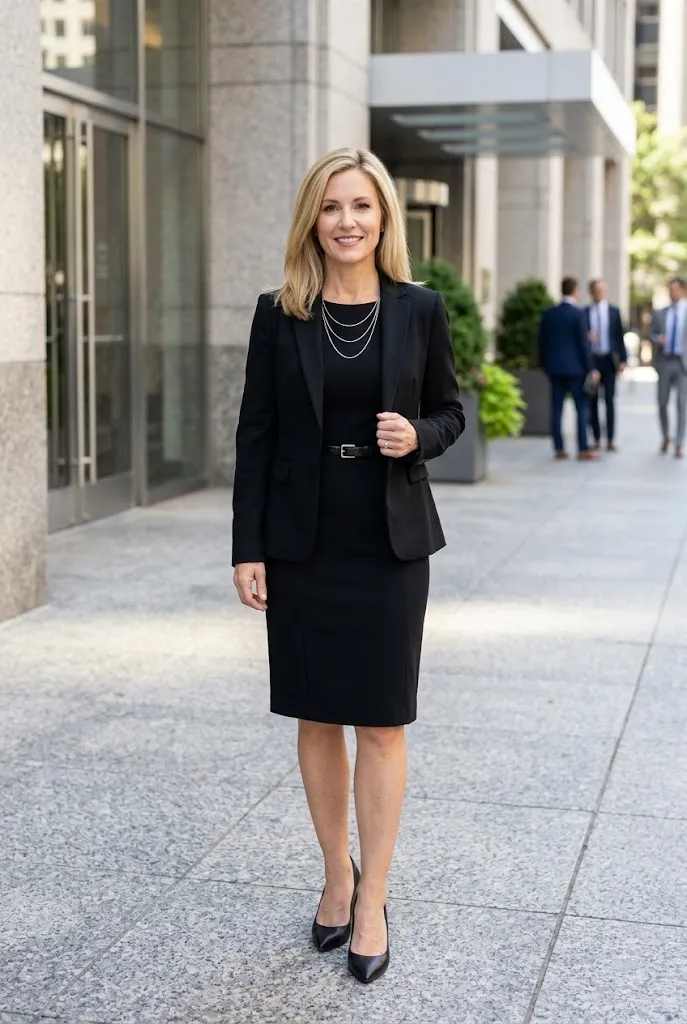
All black is the easiest outfit to reach for before an interview — and the easiest one to get slightly wrong.
The risk is a single dark column with no contrast, no definition, and nothing for the eye to land on. This look solves that problem with two small moves that cost almost nothing.
First, the belt. Even in the same black tone, a belt at the natural waist breaks the look into a defined top and skirt rather than one shapeless mass. Second, and this is the one most people skip: the layered silver necklaces. Two or three fine chains at the neckline catch the light, draw attention upward toward the face, and add just enough visual texture to stop the all-black from reading as heavy or severe.
The skirt hits right at the knee, the blazer is close-fitting, and the pointed heel keeps the leg line sharp. Nothing here is decorative for its own sake.
All-black outfits need one light-catching element at the neckline — layered fine chains do that job without adding bulk or competing with the polished, interview-ready feel of the rest of the look.
5. Skip the Blazer: Blue Blouse and A-Line Skirt for a Business Casual Interview
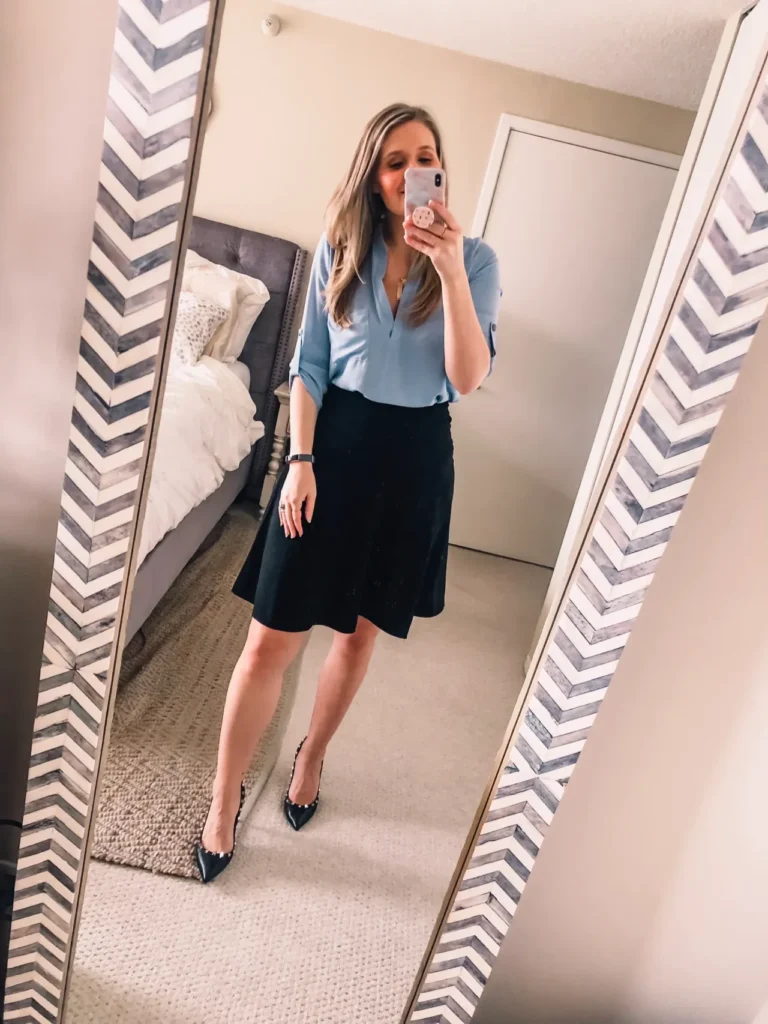
The combination is classic, but the details here keep it from feeling forgettable.
The light blue v-neck blouse is soft and slightly flowy — the kind of top that photographs well and sits comfortably through a long interview day. That gentle v-neckline is a small but reliable detail: it opens up the neckline and adds visual length, which is worth keeping in mind for every petite interview outfit you build.
The A-line skirt is the interesting choice here. Most petite style guides push pencil skirts for interviews, and they do work, but a fitted A-line at the knee is just as polished and considerably easier to move in. For interviews that involve walking tours, group settings, or anything longer than a single sit-down meeting, that ease matters more than people admit.
The studded pumps land exactly right — one deliberately chosen shoe with a design detail reads as taste, not flashiness. It is the kind of choice that feels like a real person dressed themselves rather than following a checklist.
Recreate this look
6. No Blazer Needed — If Every Other Piece Earns Its Place
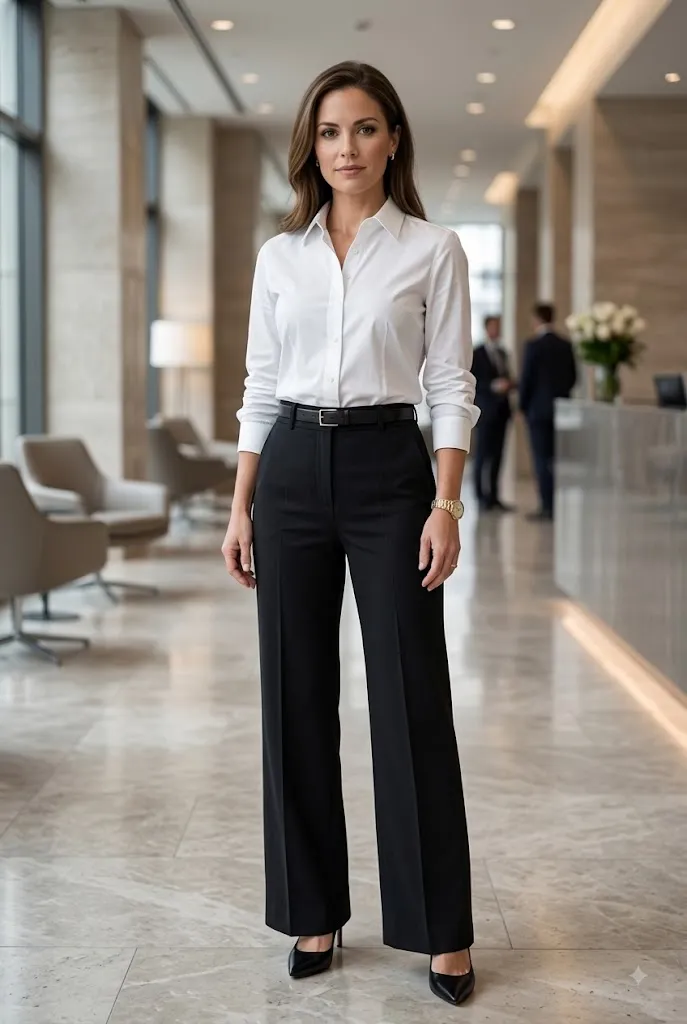
Skipping the blazer for an interview feels risky until you see it done right. The key is that every other element has to be sharp enough to hold the look together on its own.
Here, the white button-down is the anchor. It is fitted, fully tucked, and pressed clean — that level of polish makes the blazer optional rather than essential. Pair that with high-waisted wide-leg trousers and a slim black belt, and the waist is defined, the silhouette is structured, and the overall impression is just as pulled-together as a full suit.
For petites specifically, the high-rise waist is the thing that makes wide-leg trousers wearable. It places the visual break at the narrowest point of the torso, keeps the proportion balanced, and prevents the wide hem from reading as too voluminous.
The gold watch is the only warm note in an otherwise black-and-white outfit, and it earns its place by adding a subtle richness that keeps the look from feeling severe.
Start with a fitted white or light button-down shirt — nothing oversized. The cleaner the fit through the shoulders, the stronger the whole look.
Choose high-waisted wide-leg trousers and tuck the shirt in fully. A half-tuck reads as casual — a full tuck reads as intentional.
Add a slim belt in the same color as your trousers to keep the waist defined without interrupting the vertical line.
Match your heel to the trouser color so the leg line runs unbroken from hip to floor — this is the single biggest height-lengthening move in the whole outfit.
7. When the Jacket Is the Whole Point of the Outfit
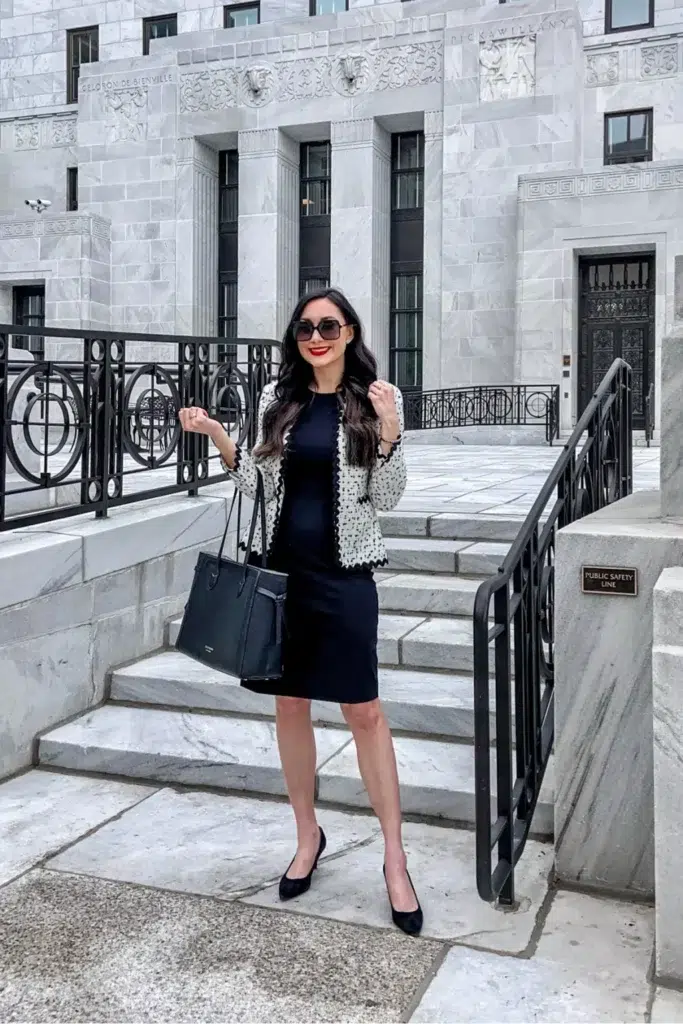
Most interview outfit advice tells you to blend in. This look makes a case for standing out — carefully.
The foundation is a fitted navy sheath dress: sleeveless, knee-length, and completely undemanding. On its own it is a perfectly safe interview choice. The tweed-style cardigan jacket layered over it is what flips the whole look into something memorable. The cream and black pattern, the scalloped black trim at the hem and edges — that detail is the kind of thing a hiring manager actually notices and remembers. It reads as considered and individual, not costume-y, because everything else in the outfit is kept deliberately simple.
Black heels, black structured tote, no visible jewelry fighting for attention. The red lip is the one bold color choice, and it works because the rest of the palette is neutral enough to absorb it.
This combination suits creative industries, client-facing roles, or any environment where showing personality is part of what they are hiring for. For a strictly conservative field, swap the statement jacket for a solid blazer and the look still holds.
8. Flare Trousers Are the Reason This Oversized Blazer Works on a Petite Frame
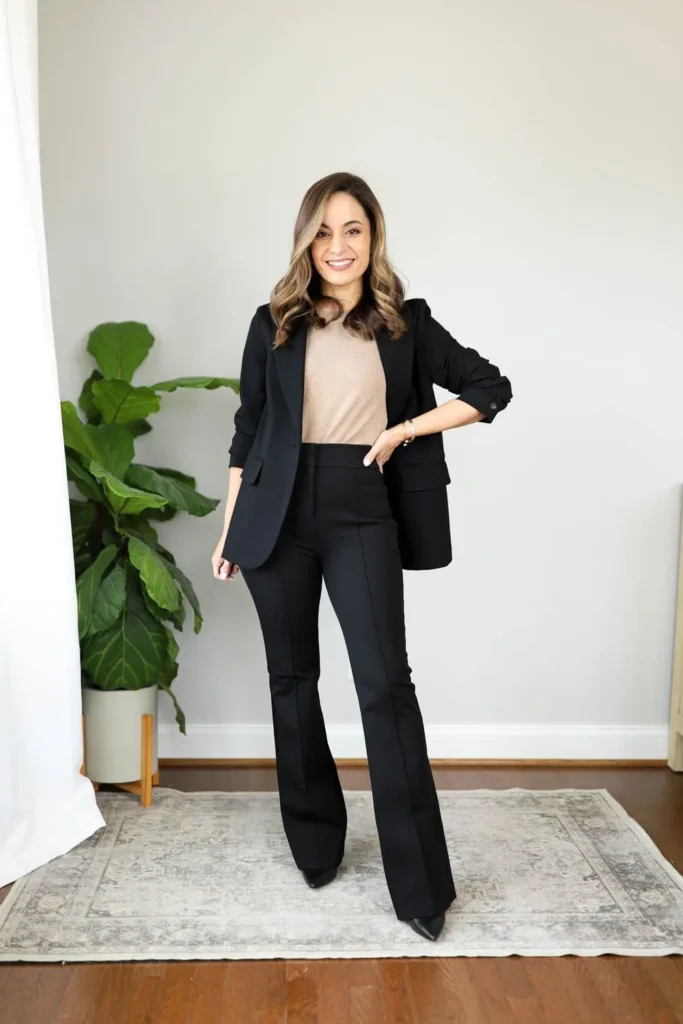
Conventional petite advice says avoid oversized blazers. This outfit is a good argument for ignoring that rule — when the rest of the silhouette is right.
The blazer here is longline and open, which on most petites would swallow the frame and add bulk where you do not want it. What balances it is the flare trouser. The wide hem at the floor creates visual weight at the bottom of the outfit, which anchors the volume of the blazer above and keeps the proportions from tipping too top-heavy. Remove the flare and put on a slim trouser instead, and the same blazer reads completely differently.
The camel knit top underneath is doing quiet but important work. It breaks the all-black with a warm neutral at the center of the look, draws the eye toward the waist, and adds a softness that stops the outfit from feeling severe. Without that warmth, the open black blazer over black trousers would lean dark and heavy.
| Oversized Blazer | Fitted Blazer |
|---|---|
| Needs a flare or wide-leg trouser to balance the volume below. | Works with slim trousers, pencil skirts, or wide legs equally well. |
| Wear open — buttoning a longline blazer on a petite frame shortens the torso. | Can be worn open or buttoned depending on the look you want. |
| Best for modern, creative, or business casual interview environments. | Suits formal and conservative industries without adjustment. |
9. Jewel Tones Belong in the Interview Room Too
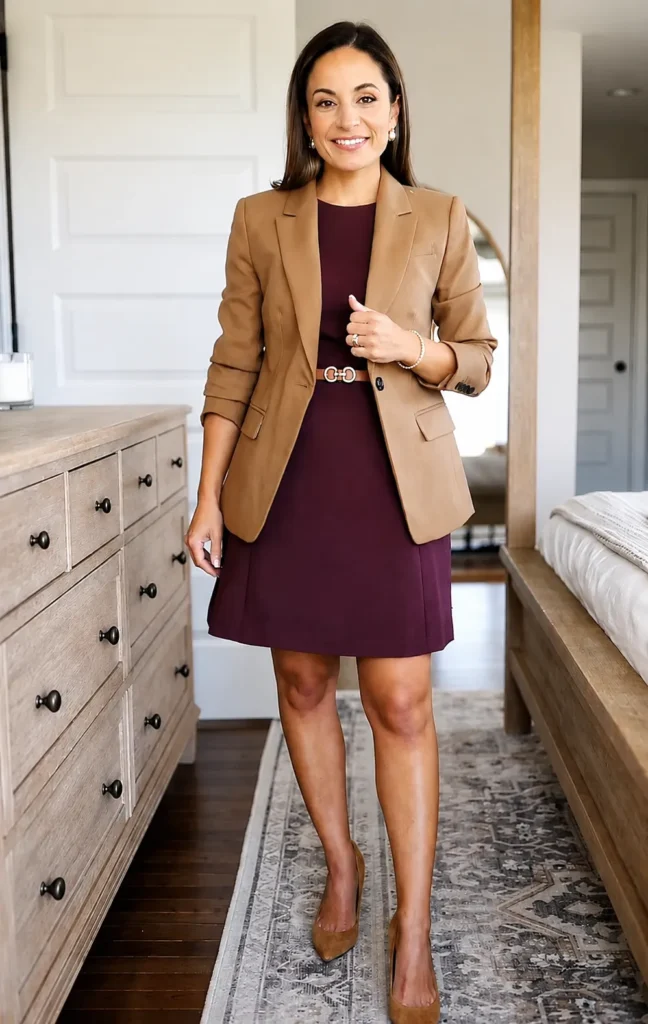
Navy and black are reliable interview colors. This look proves jewel tones are just as professional and far more memorable.
The real trick here is tonal accessorizing. The belt, heels, and blazer all pull from the same warm camel family. Three pieces sharing one color story makes the whole outfit feel deliberate rather than accidental — and that coherence reads as confidence.
The slim belt layered over the dress under an open blazer creates a defined waist without adding bulk, which is exactly what a petite frame needs from this silhouette.
One note: for conservative industries, a knee-length version of this dress keeps the same color combination while reading as more formally appropriate.
- ▸Choose a jewel tone dress — burgundy, deep plum, or forest green — as a polished alternative to standard neutrals.
- ▸Match your belt and shoes to the blazer, not the dress, for a tonal pairing that feels intentional.
- ▸Keep jewelry in one material family — all pearl or all gold — so the warm palette stays consistent.
10. Three Colors, One Rule: Give Each Tone a Clear Job
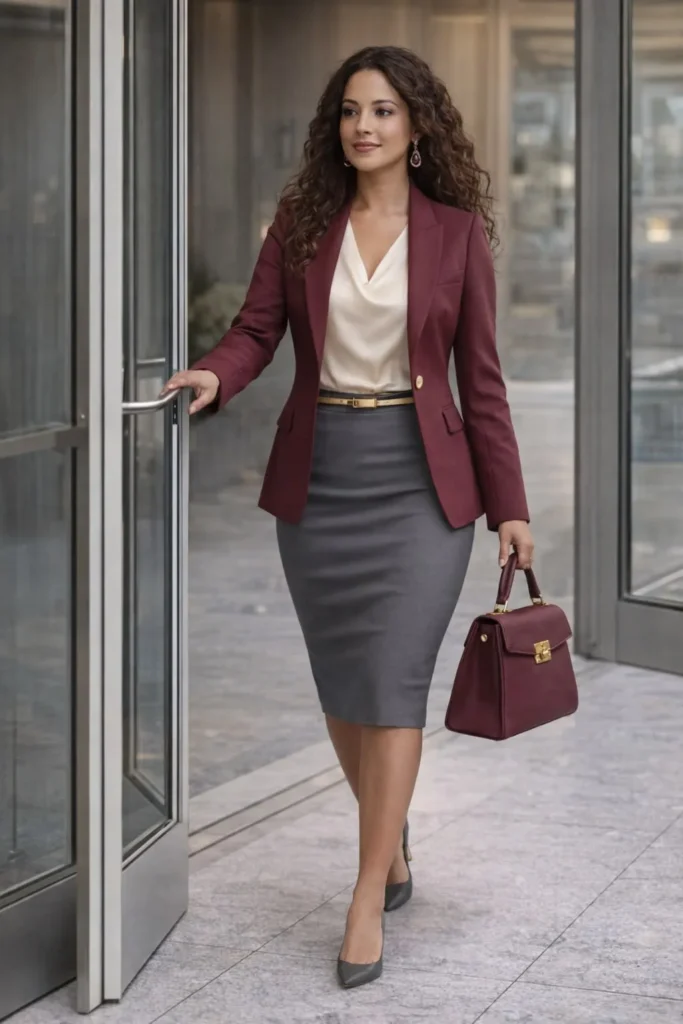
Three colors in one outfit can go wrong fast. This one stays polished because each tone has a clear role.
Burgundy anchors the look at the top and the bag, framing the outfit without overpowering it. Grey is the neutral base — pencil skirt and heels in the same shade create a seamless leg line. Cream sits at the center, drawing the eye toward the face through the soft draped neckline of the blouse.
The slim gold belt and bag hardware tie the warm tones together. Matching your bag to your blazer color is a small move that makes the whole look feel considered.
11. Not Every Interview Calls for a Blazer or a Heel
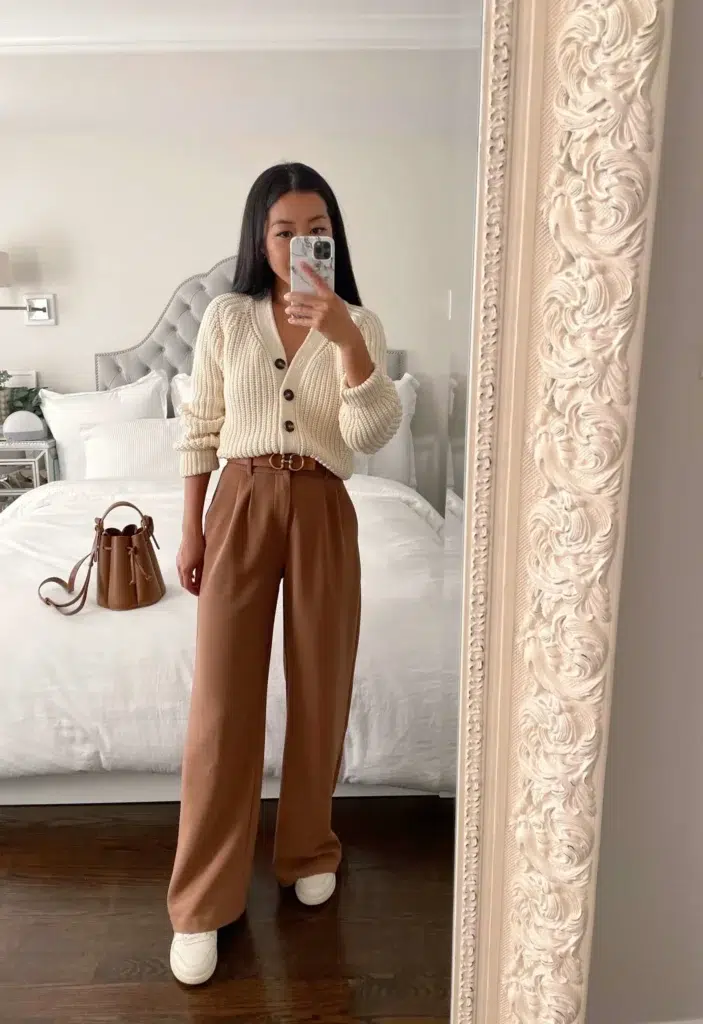
Not every interview calls for a blazer and heels. For startup, tech, or creative roles where showing up in a full suit would actually feel out of place, this kind of look hits the right note.
The high-waisted pleated trousers in a warm caramel tone do the heavy lifting here. The pleat detail reads as considered rather than casual, and the high rise keeps the proportion clean even with a slightly relaxed cardigan on top. The slim gold belt defines the waist and stops the cream-on-caramel palette from blending together.
White sneakers work here, but only clean, minimal ones. Scuffed or chunky trainers would undo the polish immediately.
⚠️ Watch Out
This outfit works for casual or creative interview settings only. If you are unsure of the company culture, swap the sneakers for a nude or caramel pointed-toe flat to keep the same relaxed feel at a notch higher formality.
12. One Bold Color Trouser, Worn the Right Way
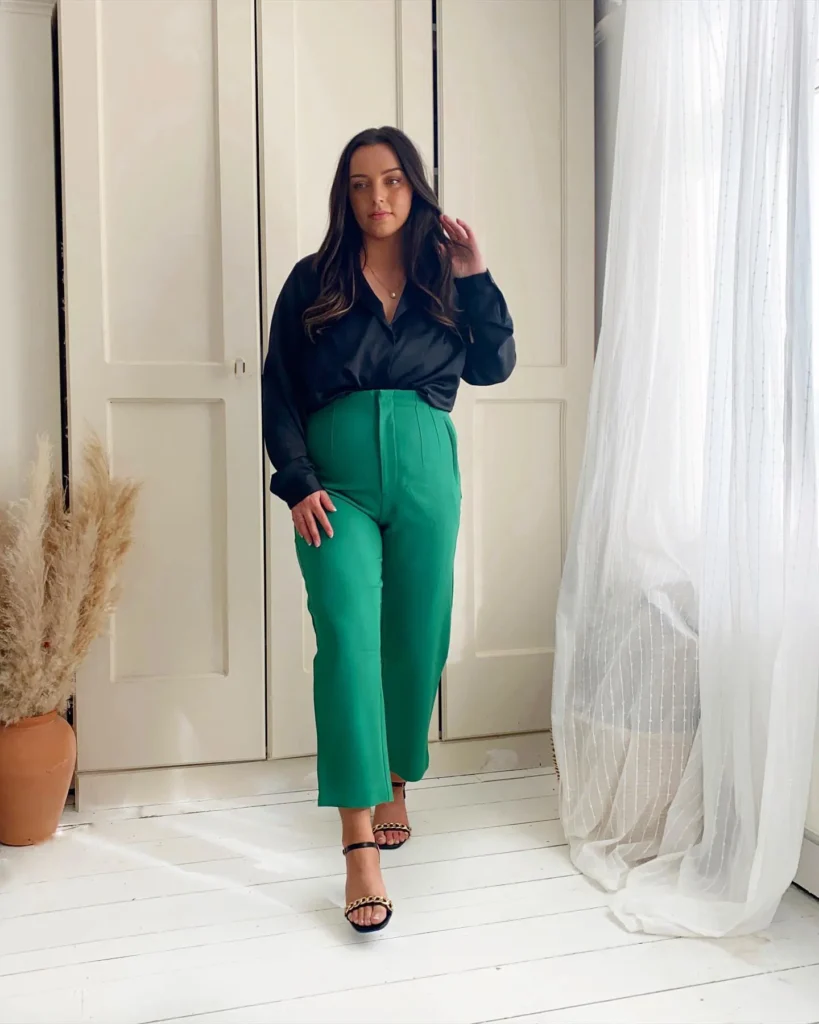
The bright green trouser is the whole point of this outfit, and in the right setting it earns its place.
Bold color trousers work in creative, fashion, marketing, or media interviews when everything else stays deliberately simple. The black shirt here is the right instinct — dark, clean, contrast without competing. For an interview, a light front tuck would define the waist and sharpen the silhouette.
Two petite-specific notes: ankle-crop trousers interrupt the leg line, so a heel that elongates the foot helps recover that length. The chain-detail sandals lean evening — a sleek black low heel carries the same energy more professionally.
Keep the top simple and dark to let the bold trouser lead.
Tuck the shirt lightly at the front to define the waist without losing the relaxed feel.
Avoid decorative sandals — strappy chain hardware reads as too casual for most interview settings.
Skip this look entirely for conservative industries — bold color trousers need the right room to land well.
13. Bow Neckline, Plaid Skirt — Two Statement Pieces That Actually Agree
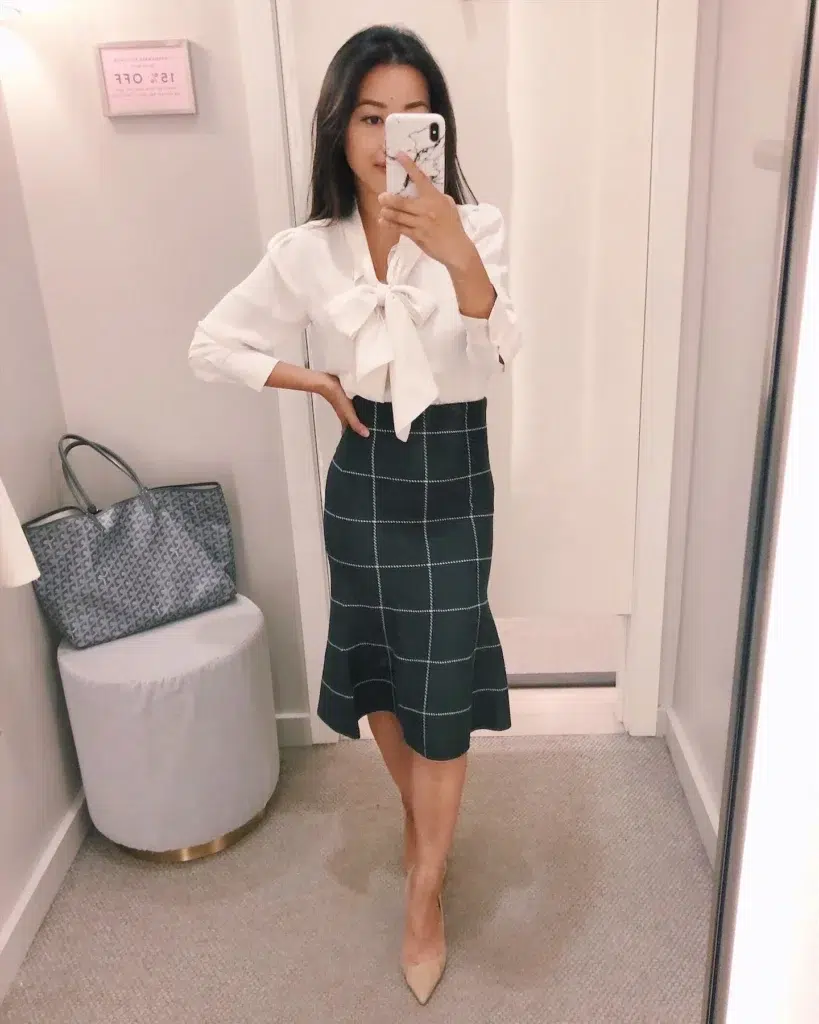
Mixing a statement top with a statement skirt usually ends badly. Here it works because the two pieces share a common language: both are classic in shape, both are office-appropriate in print and color, and neither is loud enough to compete with the other.
The bow neckline pulls the eye straight up toward the face — a genuinely useful detail on a petite frame. The fluted hem on the skirt adds movement without sacrificing the polished silhouette. Nude heels are the right call; anything darker would add a third strong element that tips the balance.
Pairing two statement pieces that clash in energy — one formal and one casual, or two competing prints — makes the outfit feel uncertain rather than intentional.
Two classic, same-formality pieces in a shared color palette — cream and deep green — feel considered and cohesive rather than busy.
14. Platform Loafers and a Collarless Jacketook
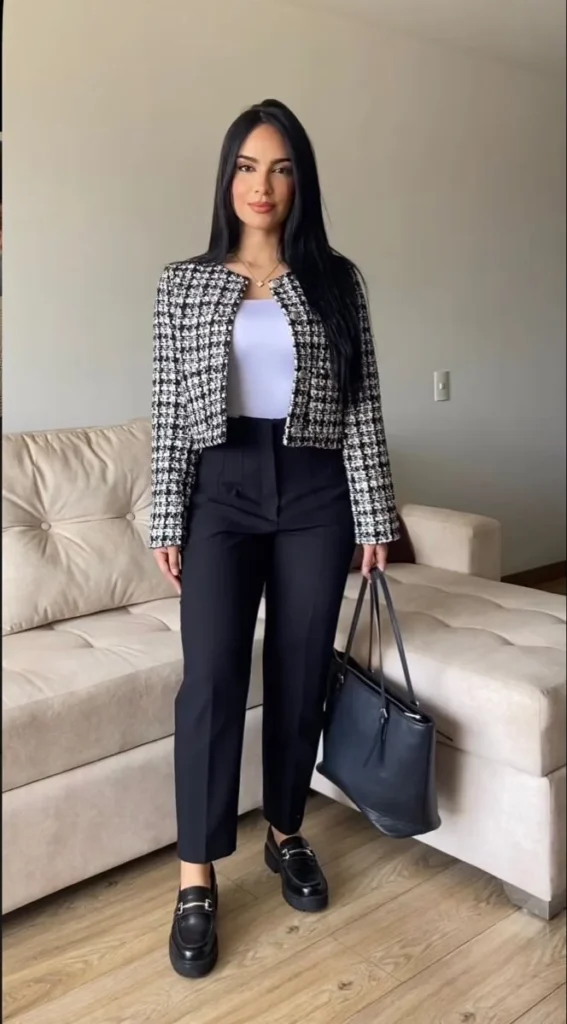
Collarless tweed jackets sit differently than a standard blazer — no lapels means the neckline stays open and clean, drawing the eye straight up rather than across the chest. On a petite frame, that is a genuinely useful design detail.
The outfit is built on high-waisted straight-leg trousers in deep navy-black. Paired with platform loafers, there is no exposed ankle to interrupt the leg. The platform adds height quietly without the effort of a pointed heel, which makes this a practical choice for longer interview days.
The soft lavender tank is a fresher alternative to the standard white — subtle enough to stay professional, different enough to be noticed.
Recreate this look
15. Flat Shoes at an Interview? This Outfit Makes the Case
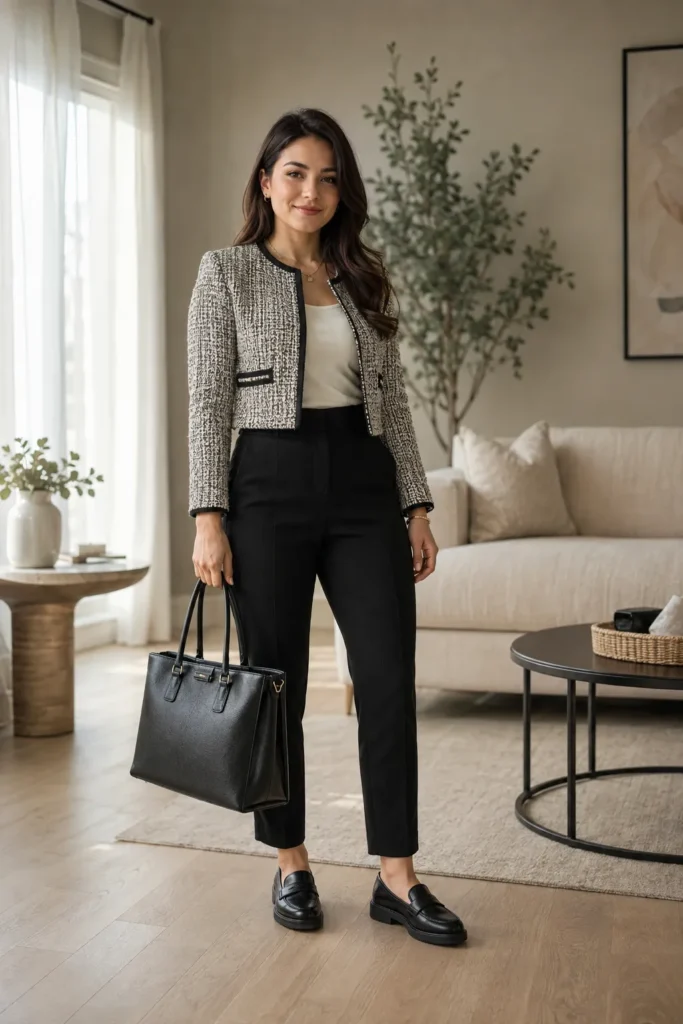
The instinct is always to reach for a heel. This outfit is a good reason to reconsider.
Flat penny loafers read as polished here because the trouser silhouette and jacket length work together to protect the proportions. Slim tapered trousers cut close to the ankle leave no excess fabric to visually shorten the leg. The cropped jacket stops right at the waistband, keeping the top half defined and the waist visible.
The warm cream tweed reads as approachable authority rather than strict formality — a tone that suits business casual and moderately formal environments equally well. A delicate necklace at the open neckline finishes the look without adding visual weight.
- ▸Slim or tapered trousers ending at the ankle let the loafer sit cleanly without cutting the leg line short.
- ▸A cropped jacket that ends at or above the waistband keeps the upper body defined when there is no heel adding height below.
- ▸Match the loafer to the trouser color so the foot reads as an extension of the leg rather than a separate element.
16. Cream Trousers at an Interview Are Less Risky Than You Think
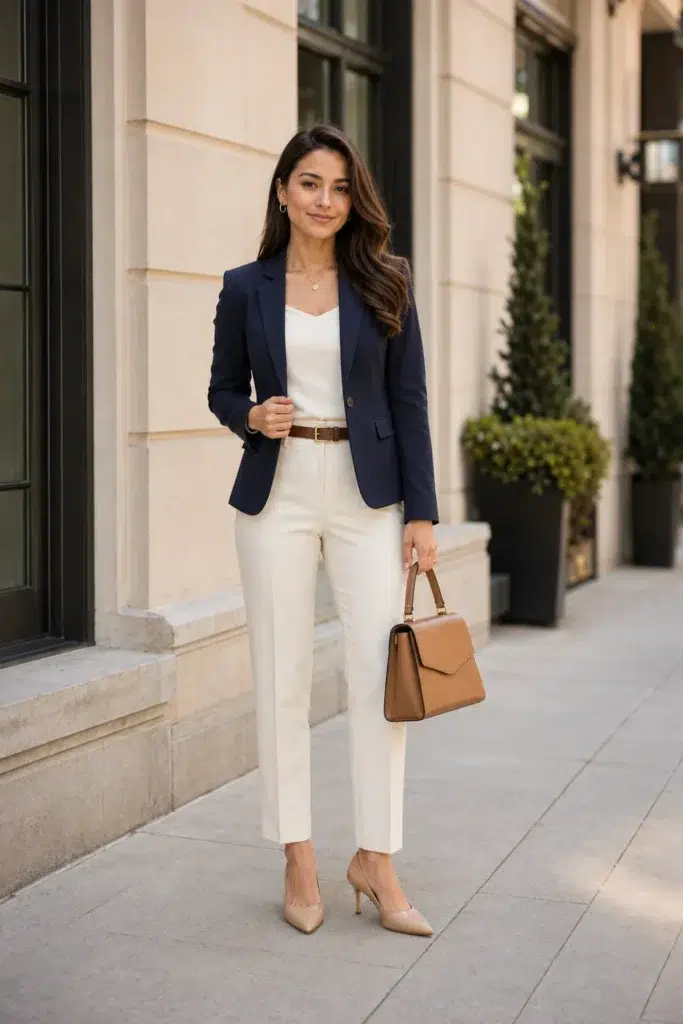
Most people avoid light-colored trousers for interviews. This outfit is the reason to reconsider.
The navy blazer anchors the look with enough visual weight to make cream trousers feel sharp rather than casual. The slim brown belt at the waist ties the cool palette to the warm camel bag — that warm-cool bridge is subtle but keeps the whole outfit from feeling cold or washed out.
Nude heels blend into the cream trousers and extend the leg line cleanly. The delicate necklace and small gold hoops keep the accessories from competing with the outfit’s clean lines.
17. Pattern Above the Waist, Solid Below
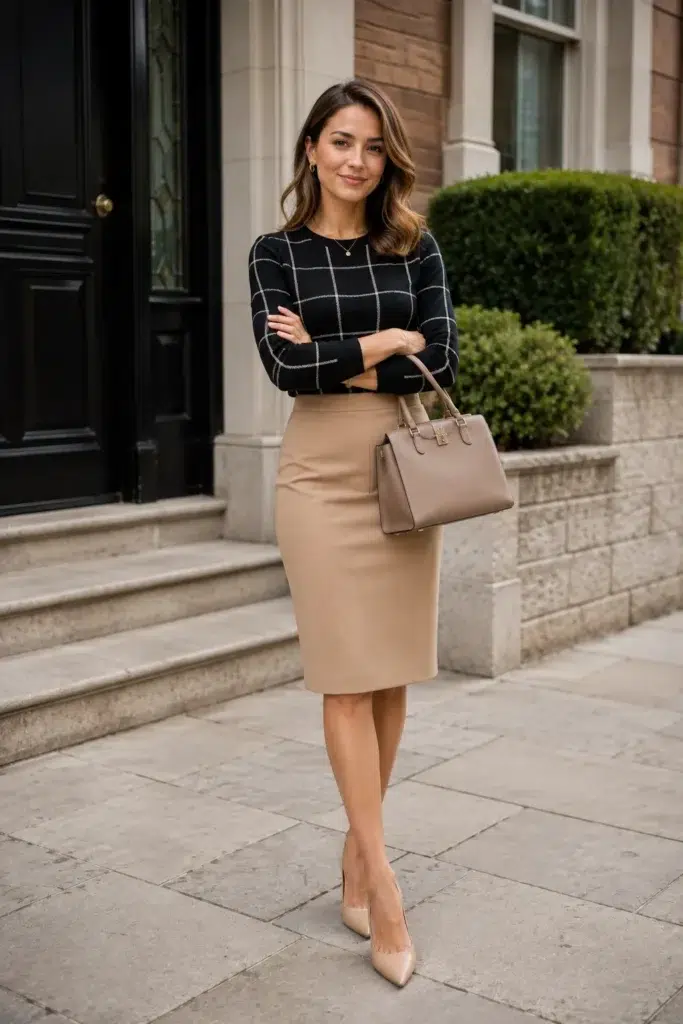
Putting a print on the top half of an outfit and keeping the bottom plain is one of those proportion rules that quietly works every time. Visual interest lands at face level, and the solid skirt keeps the lower half clean so the eye isn’t pulled in two directions at once.
The camel pencil skirt is the quieter hero here. Its warmth stops the black and white grid from reading as too stark, and the tonal pairing with the bag and nude heels means everything from the waist down reads as one uninterrupted line.
For petites, that unbroken lower half is exactly what creates the illusion of length.
Pattern above the waist draws the eye upward toward the face. A solid, neutral skirt keeps the bottom half clean and lets the leg line read long — one of the most reliable proportion moves for petite frames.
18. Wearing the Same Tone Head to Toe — and the One Rule That Keeps It From Going Flat
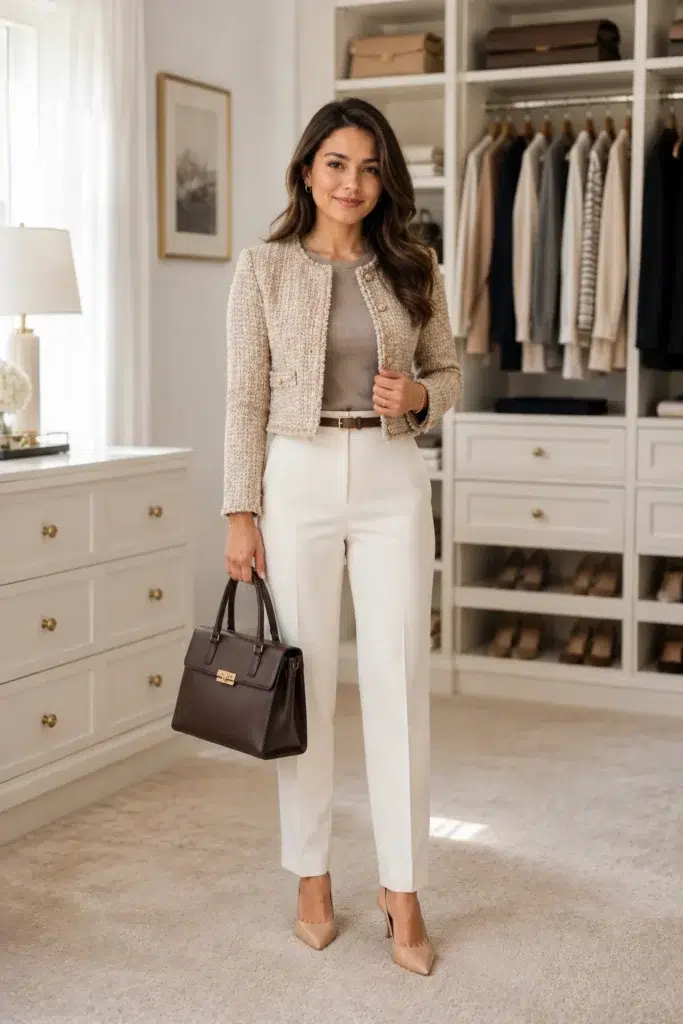
A fully tonal outfit in cream, beige, and taupe is one of the most polished things a petite woman can wear to an interview. The unbroken palette creates a single long line with no color interruption, which reads as height on a shorter frame.
The risk with all-neutral dressing is that it blurs into one pale shape. The chocolate brown bag solves that. One dark, structured anchor is enough contrast to define the look without breaking the calm of the palette.
The fringe trim on the jacket adds texture at eye level — interest without color.
💡 Quick Tip
When dressing in a fully tonal neutral palette, choose one accessory — a bag, a belt, or a shoe — in a noticeably darker shade. It gives the eye somewhere to land and stops the look from disappearing on a petite frame.
19. An All-Black Base Makes the Tweed Jacket Do All the Work
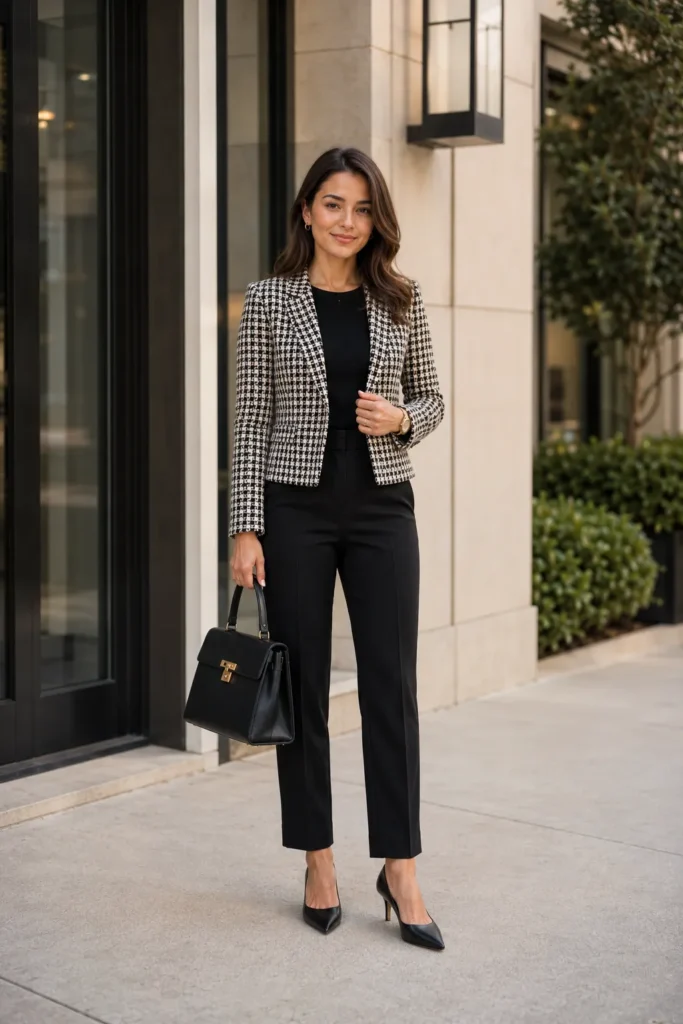
Building an outfit around a statement jacket is simpler than it looks. The foundation here is completely black — top, trousers, heels, bag — and that uniformity is intentional. When nothing underneath competes, the textured jacket reads as the clear focal point rather than one busy element among several.
This also solves a common petite dressing problem. The dark monochrome base creates one long uninterrupted vertical line. The jacket sits on top of it, adding personality at face level without fragmenting the silhouette below.
A gold watch is the only warm accent. That restraint is the right call.
| All-Black Base | Mixed Neutral Base |
|---|---|
| Statement jacket reads as the single focal point — nothing underneath competes. | Jacket shares attention with other colors — works better when the jacket is subtler. |
| Creates one clean vertical line from shoulder to floor on a petite frame. | Breaks the silhouette into sections — requires more careful proportion balancing. |
| Best when the jacket has strong texture, print, or detail worth showcasing. | Best when the jacket is a solid color and the outfit needs visual variety elsewhere. |
20. What Stops an All-Cream Suit From Reading as Flat or Washed Out
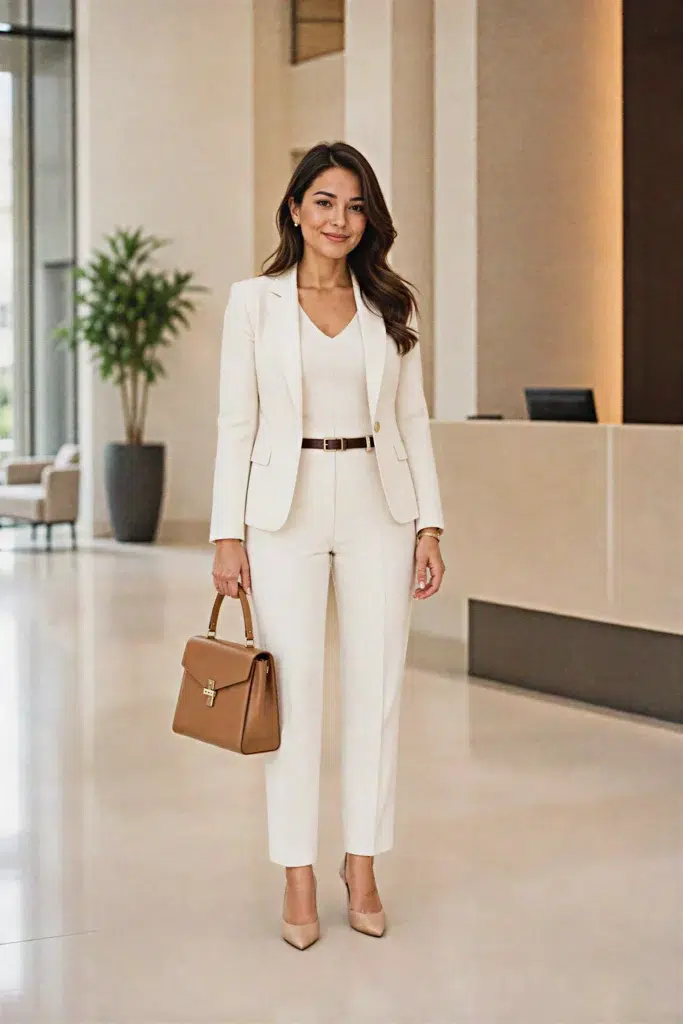
A full cream suit is a strong choice. The matching blazer and trouser create one clean, unbroken vertical line — which is exactly what a petite frame benefits from. The risk is that head-to-toe ivory can disappear, especially in bright spaces.
Two accessories prevent that here. The slim dark brown belt places a clear anchor at the waist, and the cognac structured bag introduces the only real depth in the palette. Both warm tones echo each other, which is what keeps the outfit feeling deliberate rather than accidental.
Nude heels are the only sensible shoe choice — anything darker would break the line.
Wear a matching blazer and trouser in the same cream or ivory tone — the uniformity is what creates height on a petite frame.
Add a slim dark belt at the natural waist — it defines your shape without introducing a second color family.
Choose one warm-toned bag in cognac or tan — it gives the eye a clear landing point and stops the all-cream palette from fading into itself.
21. Blush Inside a Black Suit Changes the Whole Temperature of the Look
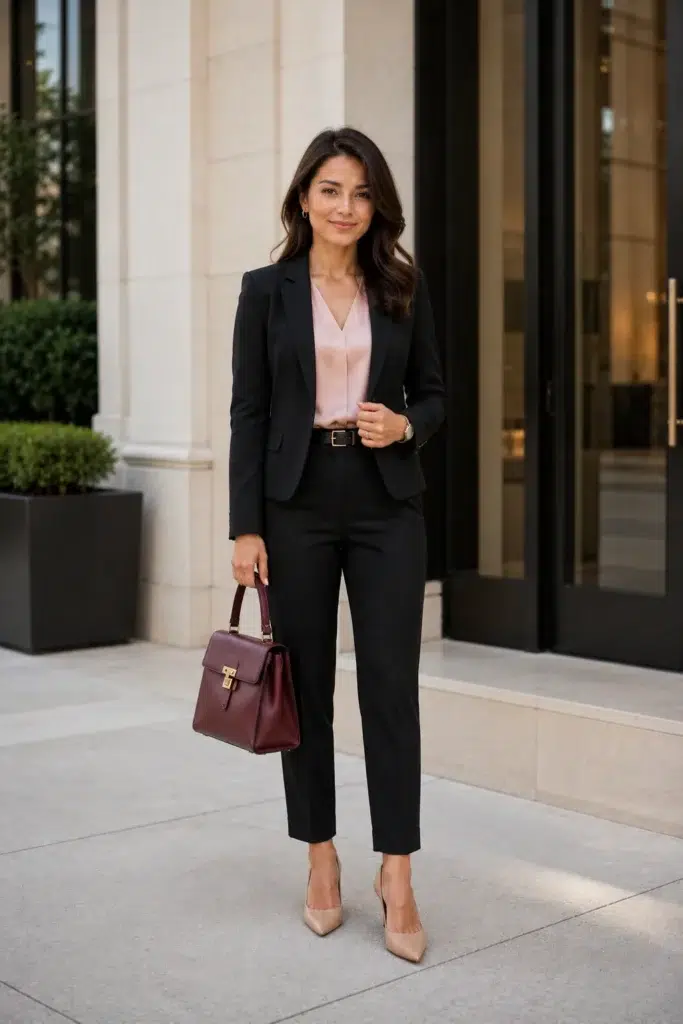
A black blazer and black trousers are about as safe as interview dressing gets. The blush satin top underneath is what makes this version feel considered rather than default.
That soft color at the neckline does three things at once: it draws the eye upward toward the face, softens what would otherwise be a stark dark column, and adds warmth that keeps the look from reading as cold or severe. The v-neckline helps too, open and relaxed without introducing a third color.
The burgundy bag is the other deliberate choice. Against black and blush, it reads as rich and confident without competing with either tone.
Conclusion
Most petite interview outfit advice stops at “wear a blazer and heels.” These 21 looks show how much more nuance there is: in jacket lengths, trouser rises, where you place a belt, and how one warm accent can keep an all-neutral outfit from reading flat.
The right outfit depends on the industry, the dress code, and how you want to feel walking through that door. But the proportion principles behind every look here apply no matter which one you choose.
Save this for the next time you need a fresh idea, or for the night before when you are standing in front of your wardrobe and your mind goes blank.