15 Petite Monochrome Outfits That Actually Lengthen Your Frame (No Height Required)

The advice to “wear more monochrome” gets handed to petite women constantly, but it rarely comes with the part that actually matters: how to build petite monochrome outfits that flatter a shorter frame rather than simply covering it in one color and hoping for the best.
The reason monochrome works for petite figures is mechanical. When the eye has no contrasting color to stop on, it travels the full length of the body in one sweep. That uninterrupted vertical line is the closest thing to an optical height booster that clothing can offer. But the shade choices, the silhouettes, the hem lengths, the shoe decisions, and even where you place a belt all determine whether the result reads as intentional and lengthening or just flat.
The 15 looks below cover everything from all-white linen sets and tonal cream midis to triple-layered grey coats, navy tailoring, and periwinkle blue co-ords. Each one breaks down exactly what is working and why, so you can take the same logic and apply it to whatever is already in your closet.
1. The White-to-Cream Tonal Look That Visually Lengthens a Petite Frame
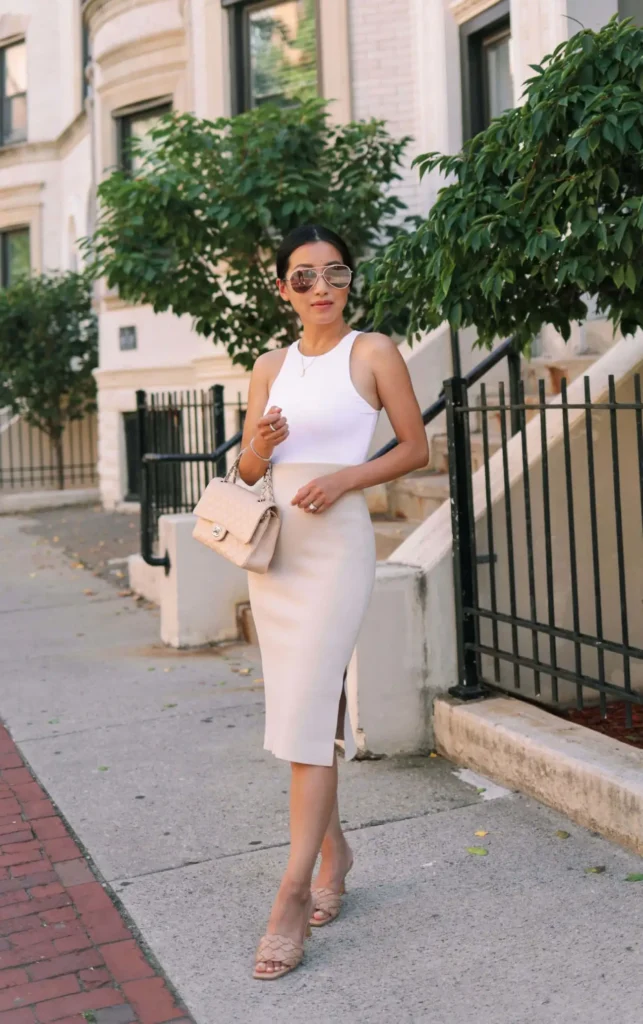
Staying within a two-shade neutral range is one of the quietest tricks in petite dressing, and this outfit is a clear example of how it plays out.
A crisp white fitted sleeveless top tucks cleanly into a cream midi pencil skirt. The pieces sit so close in tone that the eye reads them as one long vertical line rather than two separate sections. A front slit at the hem adds a little movement without breaking that upward flow.
Each choice is doing real work for the silhouette:
- Nude strappy heels blend with the skirt shade so the leg appears to continue straight through the shoe
- A fully tucked top draws in the waist without making the torso look short
- A small quilted bag in the same warm beige keeps the color story consistent all the way to the hand
- Mirrored aviators bring in personality without adding another color to compete with the outfit
Monochrome does not have to mean a single shade. A gentle tonal shift from white to cream actually reads as more considered than a head-to-toe exact match.
2. All-Navy with a Structured Vest and Pleated Midi Skirt: A Petite-Friendly Formula That Actually Works
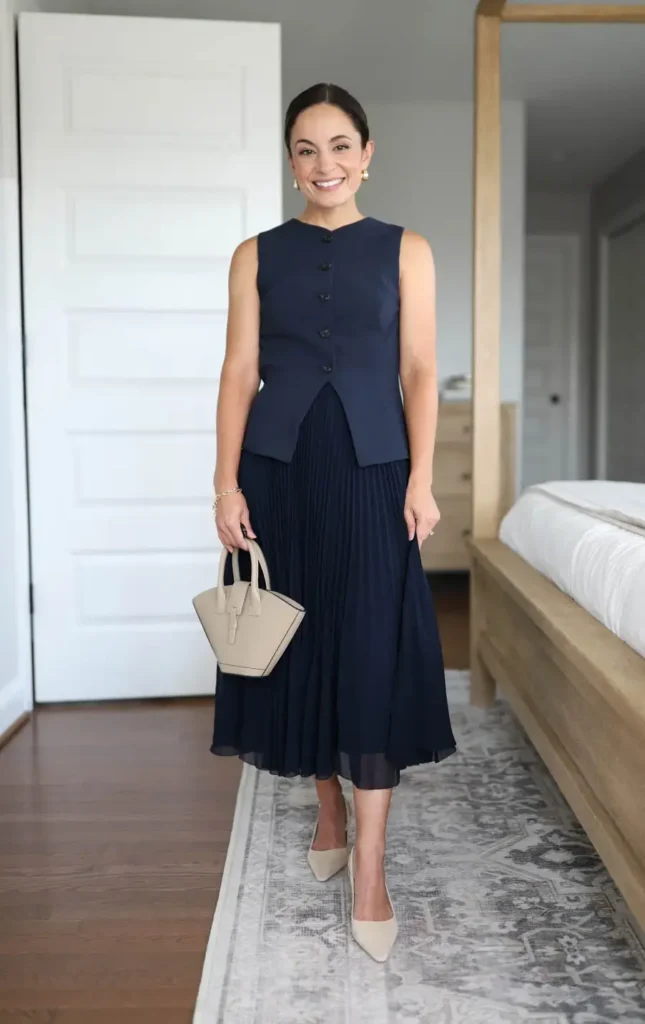
Head-to-toe navy sounds safe on paper, but this outfit shows how much variety you can pack into a single color when you play with structure and fabric.
The button-front vest is fitted and tailored. The midi skirt underneath is soft and pleated. Both are the same deep navy, so the eye travels straight up and down without stopping at a color break. For a petite frame, that uninterrupted vertical line is the whole point.
Notice where the vest hem lands: at the high hip, right where the waist begins to widen. That placement defines the figure without cutting the torso short. The pleats start exactly where the vest ends, so the transition feels smooth rather than like two separate outfits stacked on top of each other.
The nude pointed pumps are doing deliberate work here. A navy shoe would anchor the look but shorten the visible leg. A nude one blends with the skin and keeps the line running all the way down. Small structured bag in the same warm beige keeps everything coherent.
Recreate this navy monochrome look
3. All-White Jeans and a Puff-Sleeve Top: How to Make Head-to-Toe White Work for a Petite Frame
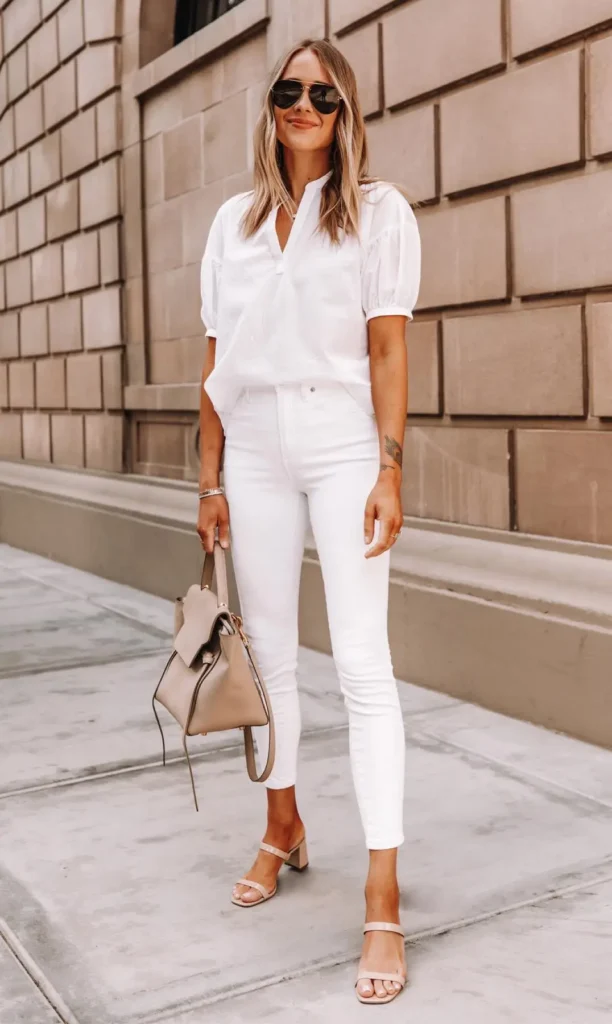
All-white is one of those combinations that can fall flat fast, especially on a shorter frame where there is less height to carry the brightness. The puff-sleeve blouse here is the detail that rescues it from looking like a blank page.
What this outfit gets right:
The sleeves have volume, but it is contained volume. They round off at the shoulder and taper toward the cuff, so they add shape without adding bulk. For a petite frame, a defined sleeve like this draws the eye upward and creates a shoulder line that feels intentional. The jeans are high-waisted and slim, keeping the lower half clean and vertical, with the hem landing just at the ankle so there is no cropping that might shorten the leg further.
Then there is the accessories strategy. The bag and sandals both stay firmly in the warm nude-beige range, so nothing competes with or interrupts the white. Even a small dark bag would create a visual break at the hip line and read as two separate halves. Keeping everything in the same warm neutral family lets the whole outfit read as one long shape from shoulder to heel.
Breaking up all-white with a dark or bright bag and shoes. The contrast creates a visual cut at the hip or ankle that divides the frame into shorter sections.
Nude sandals and a warm beige bag keep the eye moving without stopping, so the all-white reads as one tall, unbroken shape rather than two separate halves stacked on top of each other.
4. Wide-Leg Trousers in a Brown Tonal Palette: The Petite Rule Break That Actually Pays Off
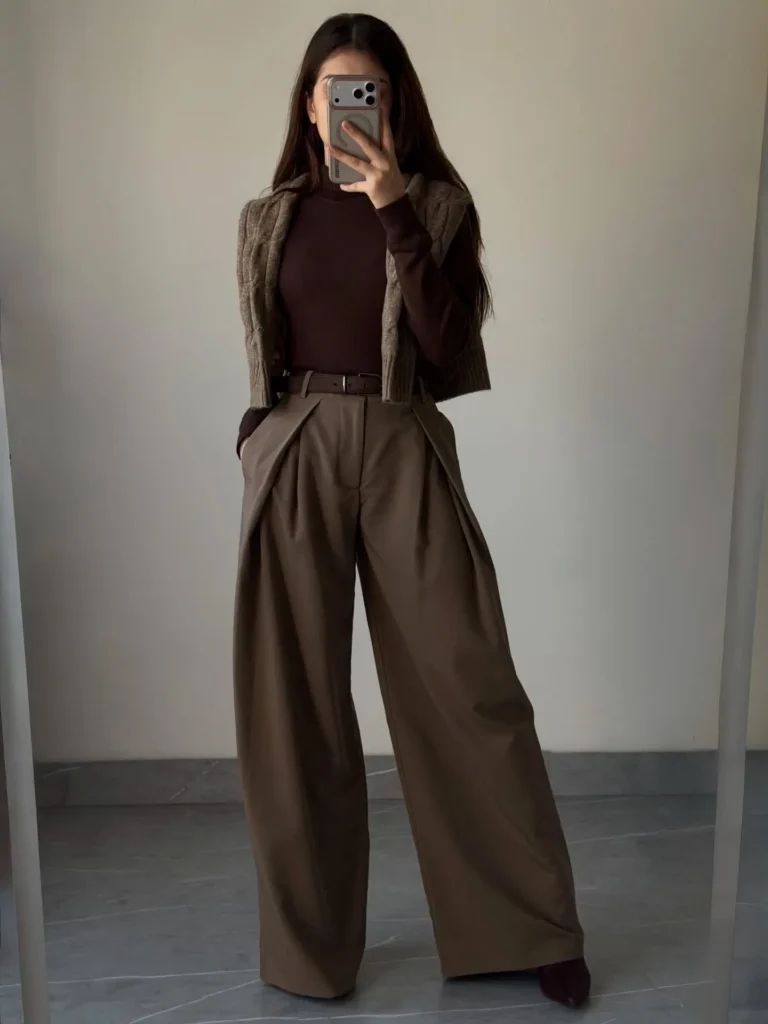
Wide-leg trousers and petite frames have a complicated reputation. The fear is real: too much fabric pooling around short legs can look like the outfit is wearing you. This mirror selfie shows exactly how to flip that around.
Three things make the wide-leg work here rather than overwhelm:
1. A high waist with a defined belt. The trousers sit at the natural waist and a dark leather belt marks that point clearly. That placement gives the illusion of a longer leg by pushing the visual starting point of the lower body as high as possible.
2. A fitted top half. The dark chocolate turtleneck is slim and close to the body. It creates contrast with the volume below, so the silhouette reads as balanced rather than bottom-heavy. The cable-knit gilet layered over it adds texture, not bulk, because it stops right at the waistband.
3. Tone-on-tone across three shades of brown. Deep burgundy shoes blend into the dark turtleneck. The gilet bridges the gap between top and trouser. Nothing interrupts the vertical flow with a color pop.
Add a belt at the true waist to anchor all that trouser volume and mark the longest point of your leg.
Keep the top half slim and tucked so the silhouette stays balanced, not bottom-heavy.
Wearing an oversized or boxy top with wide-leg trousers. The volume doubles up and the waist disappears entirely.
Flat shoes or cropped hems that cut the leg short and let the wide fabric read as shapeless rather than intentional.
5. All-Black Blazer, Shorts, and Knee-High Boots: The Leg-Lengthening Trick That Lives in the Details
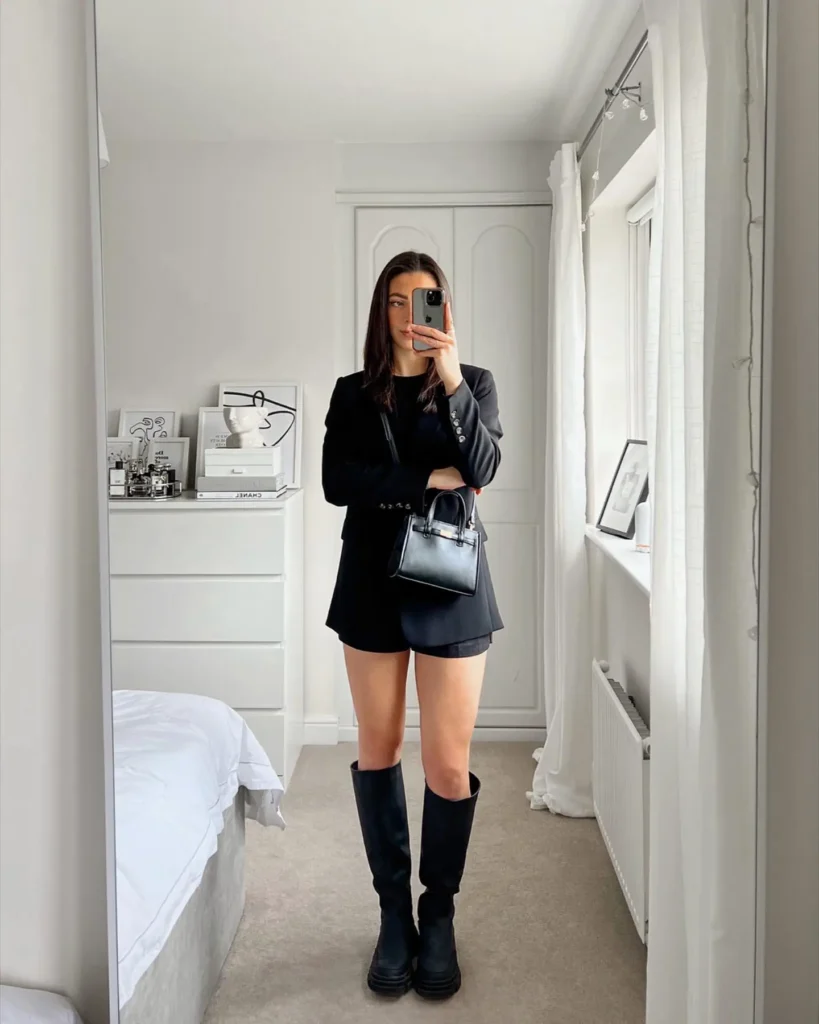
Shorts and tall boots solve a proportion problem that most petite style guides skip over entirely. When ankle boots or low-cut footwear meet shorts, a patch of bare skin floats mid-leg and visually chops the lower body into two short sections. Knee-high boots eliminate that gap.
With shorts this brief and boots this tall, there is almost no exposed skin between hem and shaft, so the eye reads the leg as one long uninterrupted stretch of black.
The blazer plays its role too. A longline silhouette with structured shoulders creates width at the top that balances the slim, covered legs below. Silver button detail on the sleeves stops the all-black from looking flat without introducing a new color. And the chunky lug soles on the boots add a small but real platform effect, the kind that adds height without requiring a heel.
Keeping the bag small and black rather than swapping in a neutral here is the final right call. A beige or tan bag would create a horizontal break at the hip that splits the silhouette in two. Black-on-black keeps everything running together.
Start with a fitted black top as your base layer. A simple crew neck or round neck keeps the neckline clean under the blazer.
Add black mini shorts. They do not need to be visible, they just need to give your legs room to move under the blazer hem.
Layer on a longline black blazer. Look for one that hits at the upper thigh so the shorts barely peek out beneath it.
Pull on knee-high boots in the same black. The taller the shaft, the longer the leg reads. A lug sole adds subtle height with no effort.
Finish with a compact structured bag in the same black. Resist the swap to a neutral here. Keeping it dark protects the unbroken silhouette.
6. White Shirt and Black Full Midi Skirt: How to Make Flat Sandals Work with Volume on a Petite Frame
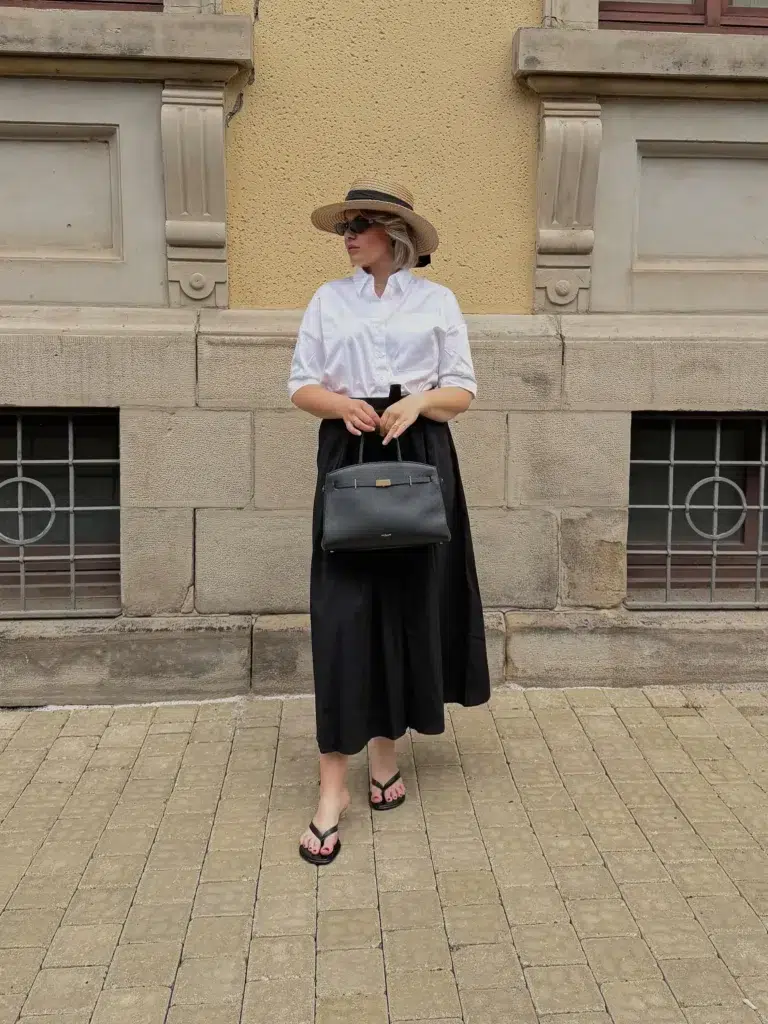
Full skirts, flat sandals, and a below-the-knee length – three things petite style guides routinely flag as risky. This outfit makes all three work at once, and the reason comes down to one decision made at the waist.
The white button-down is tucked cleanly into a high-waisted black skirt, and that single tuck sets the whole silhouette up to succeed. A clearly defined waist at its highest point gives the eye a landmark. From there, it reads the torso above and the full skirt below as two proportional halves rather than scanning for where the short person ends and the fabric begins.
The straw boater hat with its black ribbon is quieter but just as strategic. It bridges the white shirt and black skirt into one cohesive story while adding visual height at the very top of the frame. The black structured top-handle bag held in front keeps the eye centered at the waist rather than letting it drift down into all that skirt volume.
Black thong sandals disappear against the hem, which matters. A nude or white sandal here would create a pale flash at the foot that pulls attention downward and makes the skirt feel heavier than it is.
| Flat Sandals (this look) | Heeled Sandals (alternative) |
|---|---|
| Works when sandal color matches the skirt hem so there is no foot-to-fabric break. | Adds height but creates a visible contrast point at the ankle if the heel is nude or light. |
| Relies on a high defined waist to compensate for the lost heel height. Tuck is non-negotiable. | More forgiving if the waist is only loosely defined, since heel height does some of the lengthening work. |
| Best for warm weather and long days on your feet without sacrificing the clean monochrome line. | Better choice for evenings or occasions where extra polish matters more than comfort. |
7. Matching Knit Co-Ord in Taupe: Why This Two-Piece Set Is a Petite Monochrome Shortcut Worth Knowing
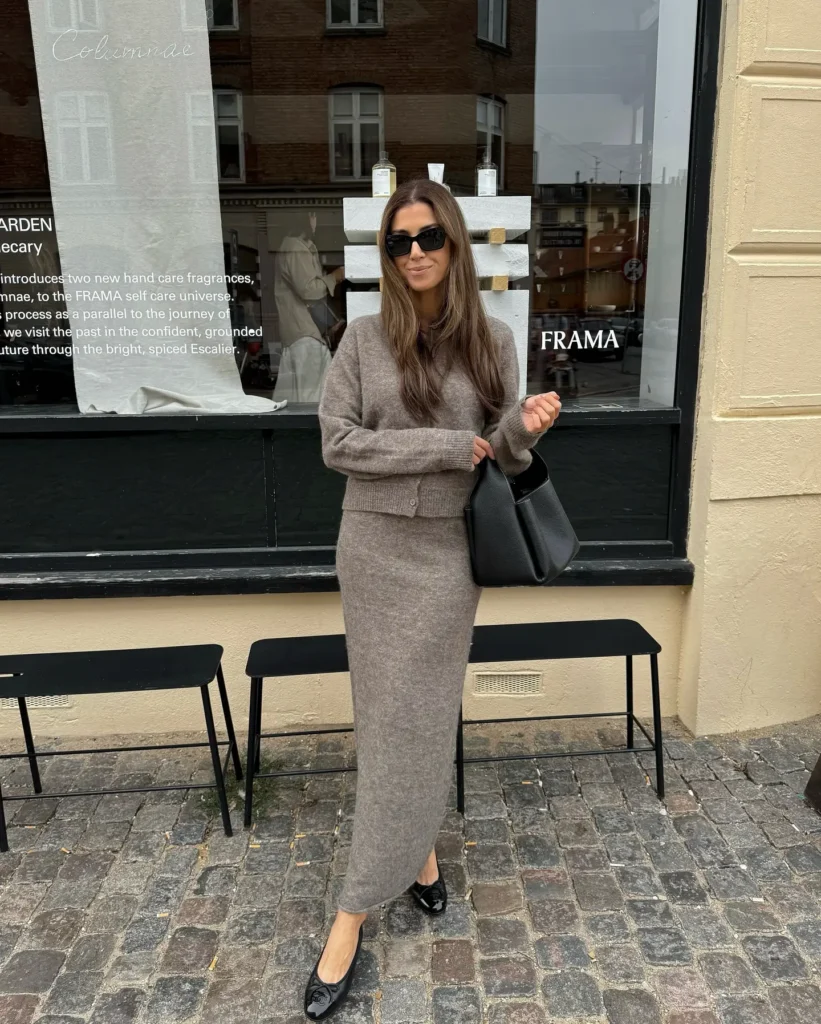
A co-ord set removes the hardest part of monochrome dressing for petite frames: finding two separate pieces in a close enough shade that they actually read as one. When the cardigan and the skirt are cut from the same heathered taupe knit, that problem disappears entirely.
The cropped cardigan buttons to a natural close at the waist, ending right where the high waist of the skirt begins. No gap, no awkward transition, just a clean continuous column of warm greige from shoulder to floor. The skirt itself earns its place on a shorter frame because it is fitted and narrow rather than full. A maxi length in a voluminous or A-line cut can overwhelm a petite figure, but a column knit maxi like this one simply extends the vertical line downward.
The contrast accessories are the one bold call in an otherwise tonal outfit. Black pointed ballet flats and a black structured bag create a grounding note rather than a jarring break, partly because the pointed toe pushes the eye forward and partly because black reads as a deliberate finish rather than a random mismatch.
One thing to watch: if the maxi skirt is too long and pools even slightly at the floor, it will flatten the silhouette fast. A clean hem that grazes the foot without bunching is what keeps this looking precise rather than swamped.
8. Longline Cream Coat Over a Ribbed Mini Dress: The Cold-Weather Petite Monochrome Formula That Earns Its Length
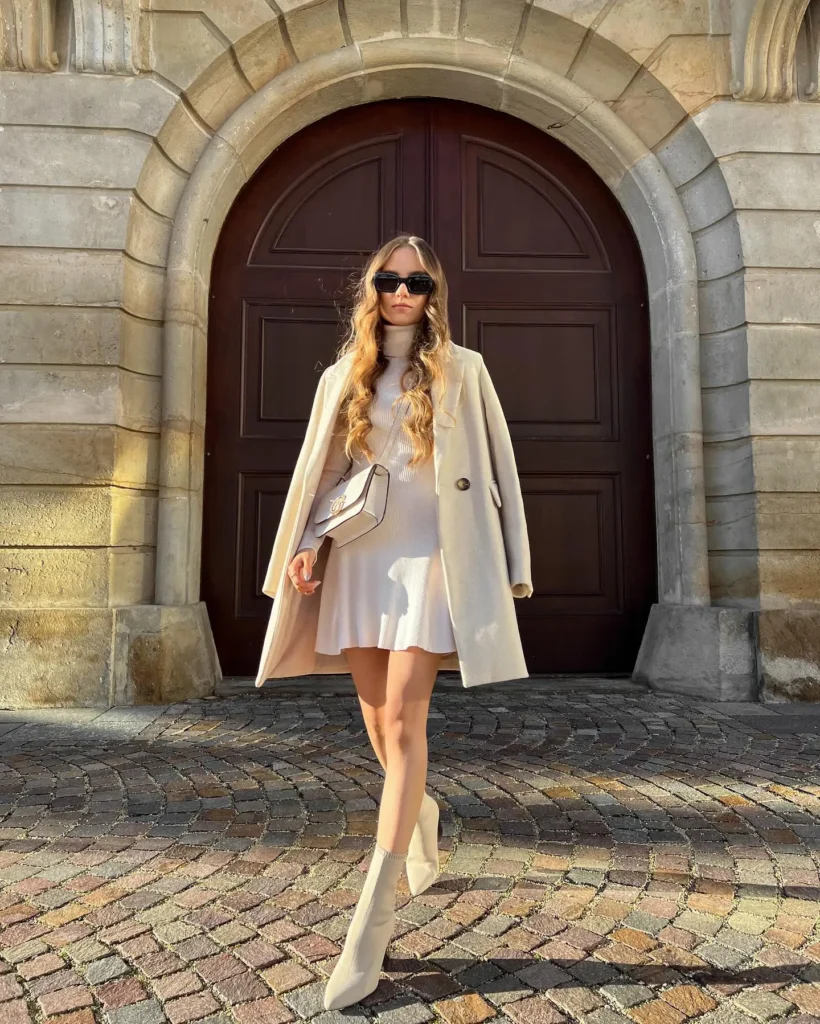
Longline coats have a reputation for swallowing shorter frames, and they will, if the outfit underneath does not do its part. The ribbed mini dress here is what makes this coat work rather than overwhelm.
The hem logic is the key idea. The coat hits well below the knee, but the dress underneath stops at mid-thigh. That exposed length of leg between the two hems creates a visual break that prevents the outfit from reading as one heavy vertical mass. The longer the coat, the shorter the dress underneath needs to be. On a petite frame, that balance is not optional, it is the whole reason the proportion works.
Three tonal layers build the cream palette here, each slightly different in warmth:
- The coat is the warmest, leaning toward camel in the golden light, with clean structure and an open front that frames rather than closes off the figure beneath
- The ribbed knit dress is a cooler soft ivory, its flared hem adding femininity without volume
- The ankle boots sit closest to the dress in tone, blending with the lower leg rather than anchoring it in a contrasting color
That gentle tonal shift across three pieces is what stops an all-cream look from feeling washed out. One flat shade head to toe can look accidental. Three close but distinct shades look considered.
The longer the coat, the shorter the dress underneath needs to be. Exposed leg between two hems is what keeps a longline coat from collapsing the silhouette on a shorter frame.
9. Black Turtleneck and Column Maxi Skirt: How Gold Accessories Rescue an All-Black Monochrome Outfit
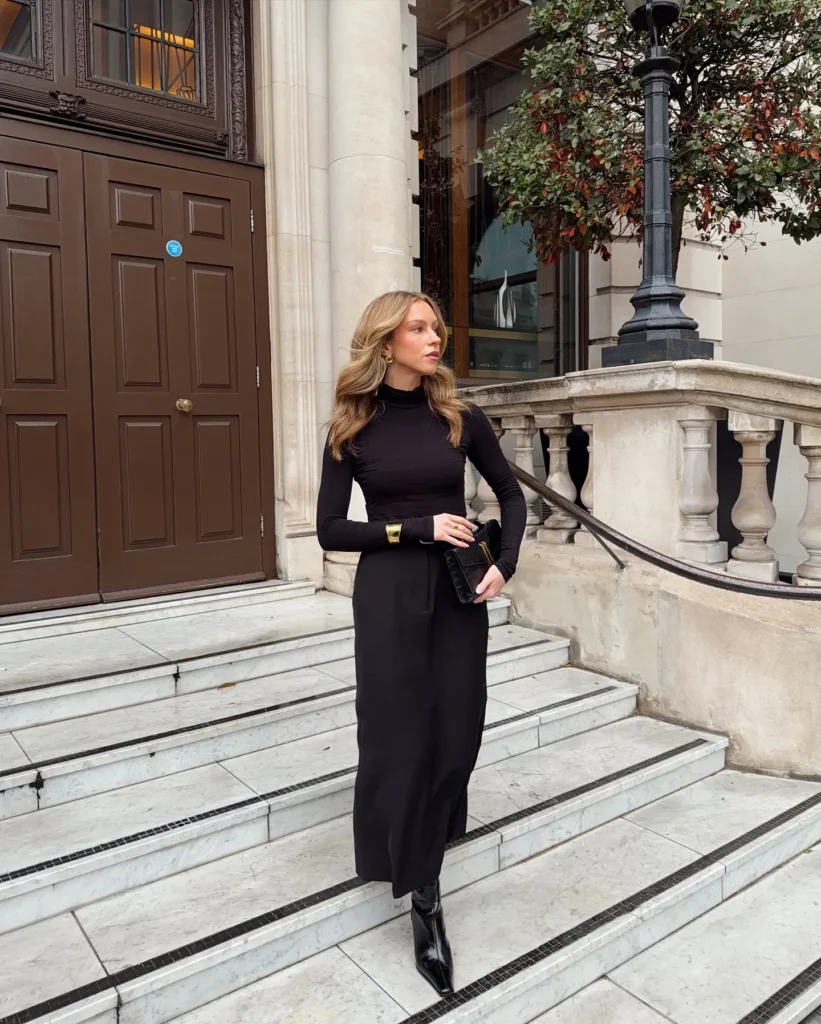
Gold is doing more heavy lifting here than it looks like. An all-black column outfit can flatten quickly, especially on a petite frame where there is less height to give the darkness somewhere to travel. A chunky gold cuff at the wrist, small gold earrings, and gold hardware on the bag create three light-catching points that pull the eye upward along the body rather than letting it sit at the hem of a long dark skirt.
The silhouette itself is deliberately simple. A fitted long-sleeve turtleneck tucks into a straight, floor-grazing maxi skirt. No waist definition from a belt, no visible seam between the two pieces, just one clean column of black from collar to ankle. For a petite frame, that unbroken vertical is one of the most effective lengthening tools available, provided the pieces both fit close to the body.
The ankle boots matter here in two ways. The pointed toe extends the line of the skirt downward, and the patent finish catches light at the foot, which stops the hem from disappearing into shadow. A matte boot in the same shade would have been fine, but the slight sheen gives the whole look a finished, intentional quality that reads clearly even at a glance.
10. Cream Tweed Co-Ord with Black Trim: How Consistent Contrast Stitching Makes a Two-Tone Outfit Read as Monochrome
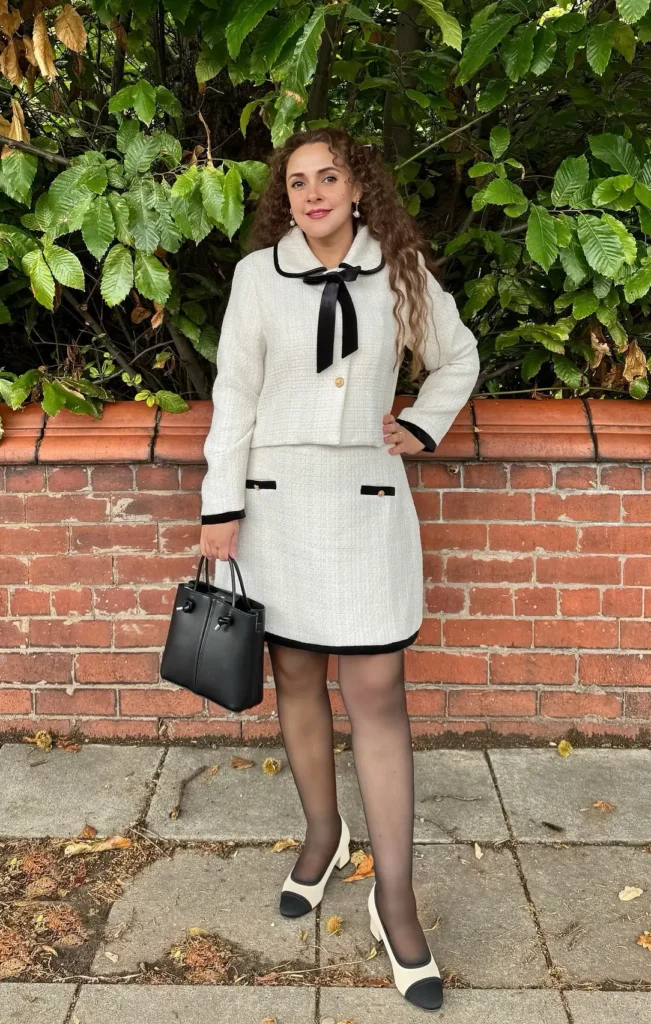
Cropped jacket, mini skirt, and a generous stretch of leg between hem and shoe. That proportion combination is one of the friendliest silhouettes a petite frame can wear, and this ivory tweed co-ord shows exactly why it works so reliably.
What makes this interesting as a monochrome outfit is the black trim. It runs along the jacket collar, cuffs, and hem. It edges the skirt pockets and hemline. It appears again in the velvet bow at the neck, the bag, and the cap-toe on the shoes. Because the same black accent repeats in every single layer, the eye reads it as a design system rather than a color clash. The result is a two-color outfit that functions like a monochrome one.
The proportion formula doing the work: The jacket is deliberately cropped, ending right at the natural waist. The skirt is a mini, ending at mid-thigh. Together they expose a long vertical of leg that reads as height. A longer jacket or a longer skirt would have eaten into that visible leg length and shortened everything.
The tights tip most people skip: Black sheer tights here are not just a cold-weather fix. They bridge the gap between the skirt hem and the two-tone heel, pulling the black accent from the outfit all the way down to the foot so the monochrome story does not stop abruptly at bare skin.
- ▸Choose a tweed or boucle co-ord where the jacket is cropped, not hip-length. Hip-length jackets cover the waist and shrink the visible leg.
- ▸Match the trim color across every layer including shoes and bag so the accent reads as intentional, not accidental.
- ▸Add sheer tights in the trim color to extend the monochrome line from skirt hem to shoe without bare skin breaking the story.
- ▸Keep jewelry delicate and in one metal tone only. Pearl drops or small gold studs work. Anything larger competes with the collar detail.
11. Grey-on-Grey Knit and Wide-Leg Trousers: The Parisian Off-Duty Monochrome That Petite Women Actually Can Wear
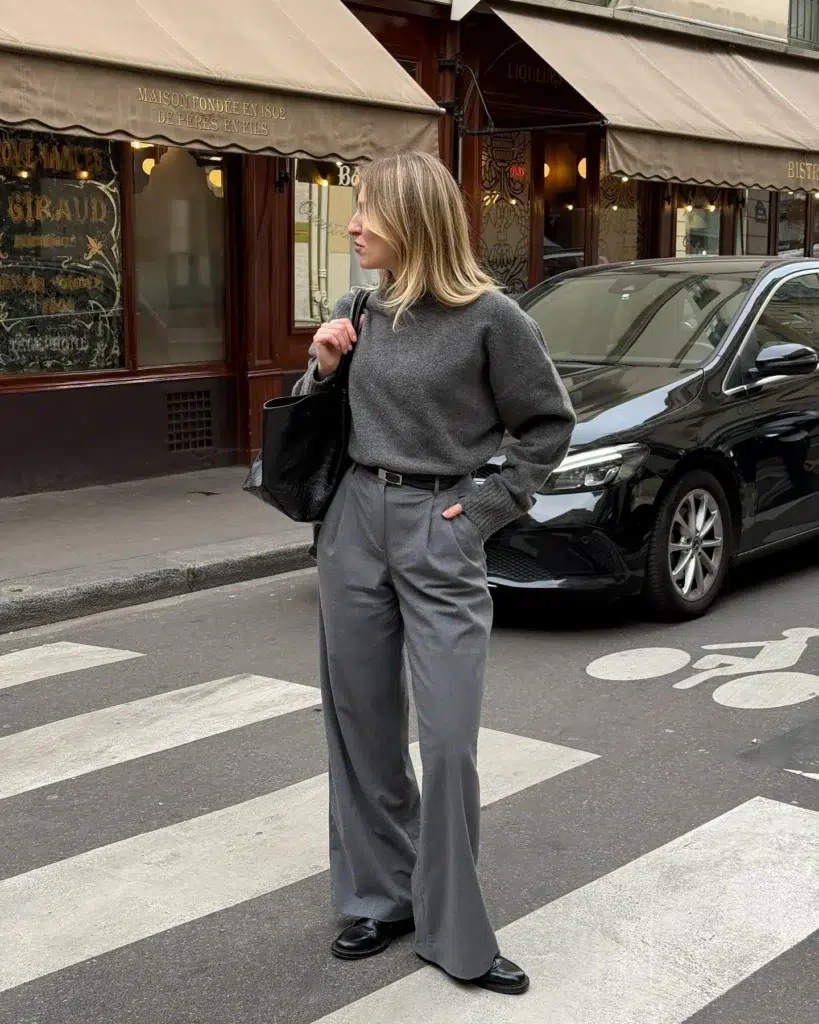
Grey is the underrated monochrome choice. Black can feel heavy on a short frame when it pools all the way to the floor, and brown asks for careful accessorizing. A grey tonal palette sits between those two and delivers the same elongating line with a lighter, softer quality that photographs well in any light.
The specific shade split in this outfit is worth noting. The chunky knit is a darker, heathered charcoal. The wide-leg trousers are a lighter, cooler mid-grey. Darker on top, lighter below.
That reversal is counter-intuitive since most styling advice puts the lighter piece up top and the darker piece down, but here it works because the tailored trouser fabric reads as structured and intentional, so the volume below does not feel sloppy or overwhelming.
Both pieces carry volume, which is the genuine challenge. The knit has relaxed, slightly full sleeves. The trousers are wide and pleated. On a petite frame, volume at both ends without a defined middle is where things go sideways fast. The thin black belt at the natural waist is the one element preventing that. It is quiet, but it is absolutely necessary. Without it, this becomes two shapeless grey pieces stacked on top of each other.
Black loafers, a black tote, and a simple black belt keep the grounding consistent without competing with the grey story.
💡 Quick Tip
If you are wearing two voluminous pieces in the same colour family, a thin belt at the natural waist is non-negotiable. It does not need to be bold or wide. Even a simple narrow belt in a contrasting shade gives the eye a waist to find, which stops the outfit from reading as a shapeless column of fabric on a petite frame.
12. Sandy Beige Monochrome with a Leopard Belt: The One Pattern Exception That Actually Strengthens a Tonal Look
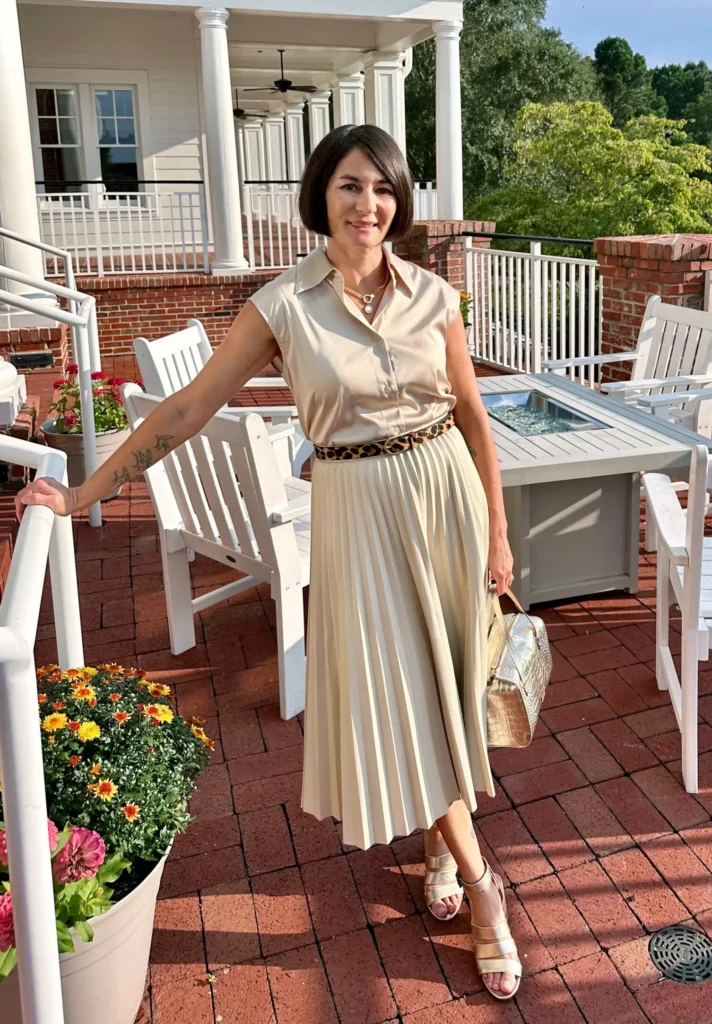
Leopard print in a monochrome outfit sounds like a contradiction. But look at how this one works, and the logic becomes clear fast. The belt is the single narrowest piece in the entire outfit. A slim animal-print belt at the natural waist is not competing with the beige palette, it is marking it. It gives the eye a precise place to land between a collared cap-sleeve top and a fine-knife pleated midi skirt, both in the same warm sandy tone.
Without that belt, this outfit risks reading as a soft shapeless column. The two pieces sit so close in color that the waist could simply disappear. The print does the defining work that a tonal belt in the same beige could not quite achieve because there would be nothing for the eye to catch.
The gold accessories carry the second idea worth borrowing. Metallic gold is not technically a neutral but it functions as one inside a warm beige palette. The block-heel sandals, the croc-embossed bag, and the layered necklaces all share the same warm gold register, so they read as part of the tonal family rather than a statement layer dropped on top. The effect is a petite monochrome outfit that feels finished and rich without a single contrasting color in sight.
Start with a fitted collared top in a warm sandy or khaki tone. A cap sleeve or sleeveless cut keeps the look from feeling heavy in warmer months and bares the arm for a longer line.
Pair with a fine pleated midi skirt in the same warm neutral family. Fine knife pleats stay controlled and slim, unlike wider box pleats which add bulk at the hip.
Add a slim belt at the natural waist. If the two pieces are very close in shade, a subtle print belt in warm tones does the defining work that a matching tonal belt cannot quite manage on its own.
Finish with gold metallic shoes and a gold bag. Inside a warm beige palette, gold reads as a natural extension of the tonal story rather than an accent color, so the monochrome reads intact all the way to the ground.
13. Periwinkle Blue Linen Set: Why Cropped Wide-Leg Trousers Work Where Full-Length Ones Often Don’t
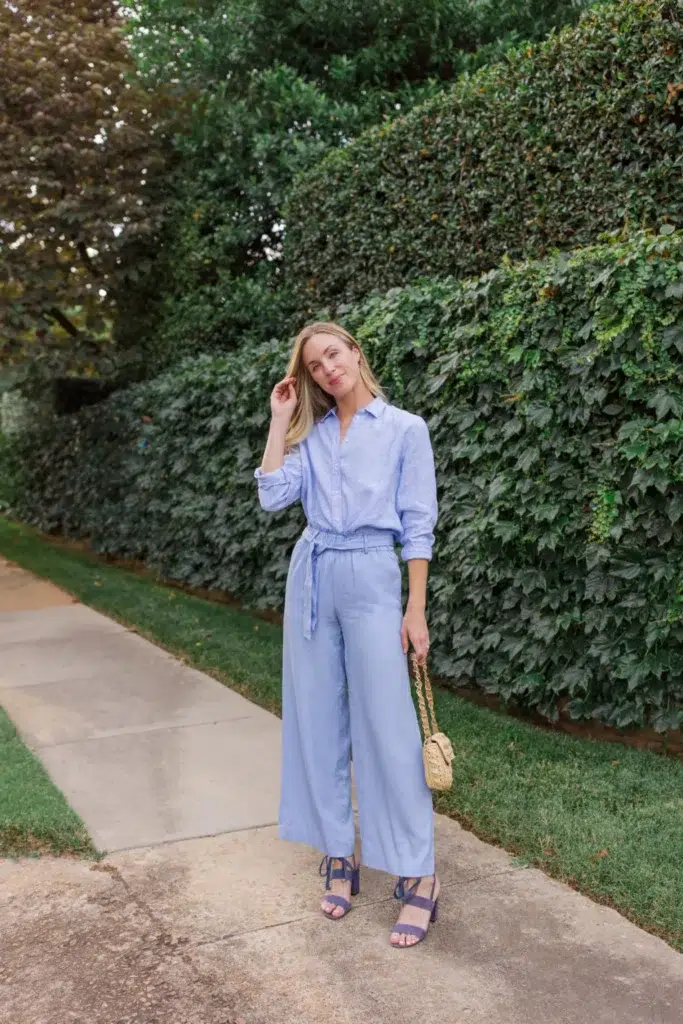
Wide-leg linen trousers on a petite frame almost always come down to one question: where does the hem land? Full-length wide-leg trousers in a lightweight fabric can drag, bunch, and create a shapeless base that eats into the visible leg. The culotte or cropped wide-leg cuts that problem clean off at the ankle, and this periwinkle linen pair shows the result. The hem clears the foot with room to spare, so the sandal is fully visible and the leg reads as finished rather than swamped.
The self-tie drawstring waist built into the trousers is the other quiet win. A fabric sash in the same blue tied loosely in front creates waist definition without requiring a separate belt, and because it is the same material as the trousers, it stays inside the monochrome story completely. The linen shirt tucked in at the front adds to that softly defined middle without going tight or structured.
Navy lace-up block heels anchor the blue palette with a slightly deeper shade at the foot. The small woven straw bag is the only real textural contrast in the outfit, and it earns its place by adding warmth and lightness without introducing a competing color.
14. Oversized Taupe Knit and Black Micro Mini with Knee-High Boots: The Two-Block Monochrome That Works Like One
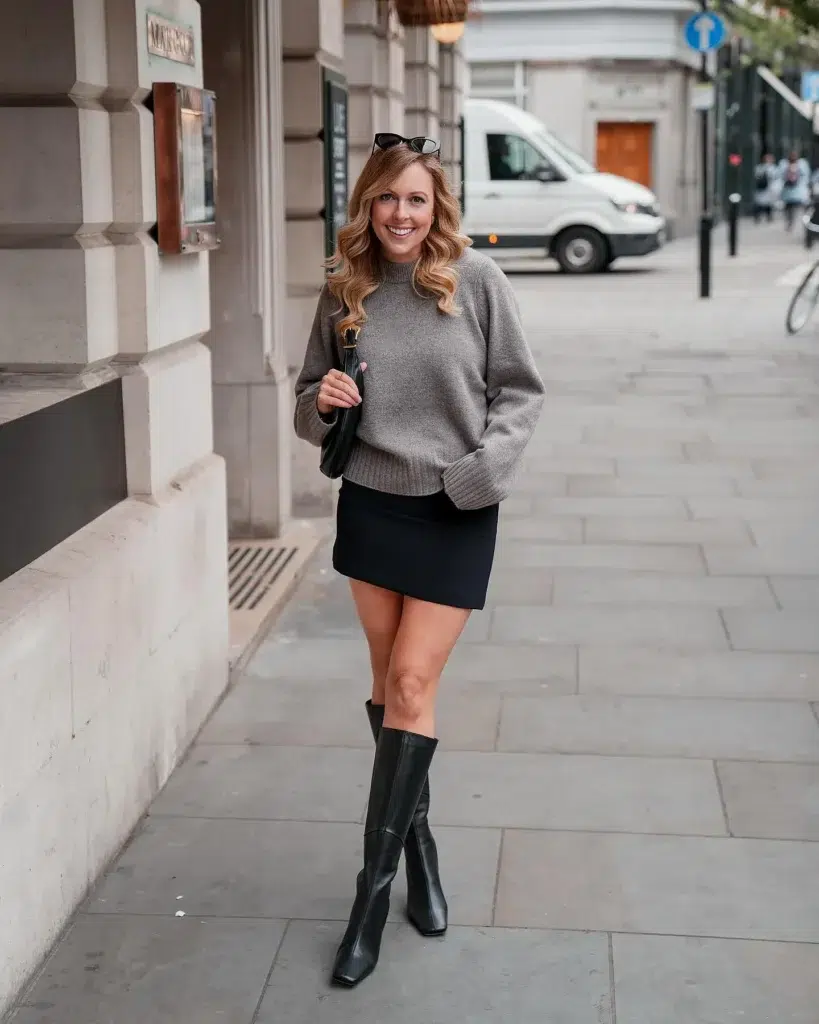
Technically this is a two-color outfit. In practice, it reads like a monochrome one, and the reason is all about how the black is distributed. The micro mini skirt and the knee-high boots form a single unbroken dark block from mid-thigh to floor. There is no patch of bare leg between them long enough to register as a gap. The eye reads the entire lower half as one shape, and the warm taupe chunky knit sits cleanly on top of it.
The sweater hem placement matters more than most people realize. It ends just above the skirt waistband, which means the black begins right where the knit stops. A longer sweater that covered the skirt would erase that division entirely and turn the whole outfit into a shapeless oversize knit situation. A shorter cropped version that sat well above the waistband would show too much skirt and make the proportion feel off on a petite frame. Right at the waistband is the exact landing point that keeps both pieces readable.
Wide ribbed cuffs on the sleeves add visual weight at the wrist without broadening the shoulders, a detail that keeps the oversized silhouette feeling considered rather than sloppy. The heeled knee-high boot, slimmer than a chunky lug sole, adds actual lift and keeps the dark lower block from looking heavy at the foot.
Let the sweater hem land right at the skirt waistband so the two blocks meet cleanly without a gap or too much overlap.
Choose a knee-high boot with a slim shaft and a modest heel. The slimmer profile keeps the dark lower block from reading as heavy at the foot.
Wearing a hip-length sweater with this formula. It covers the skirt waistband and turns the whole look into one long shapeless knit with boots poking out beneath.
Adding a neutral or contrasting bag that breaks the two-block system. Keep the bag dark to stay inside the lower half’s color story.
15. Triple-Layer All-Grey with an Oversized Longline Coat: The High-Drama Petite Monochrome That Actually Works
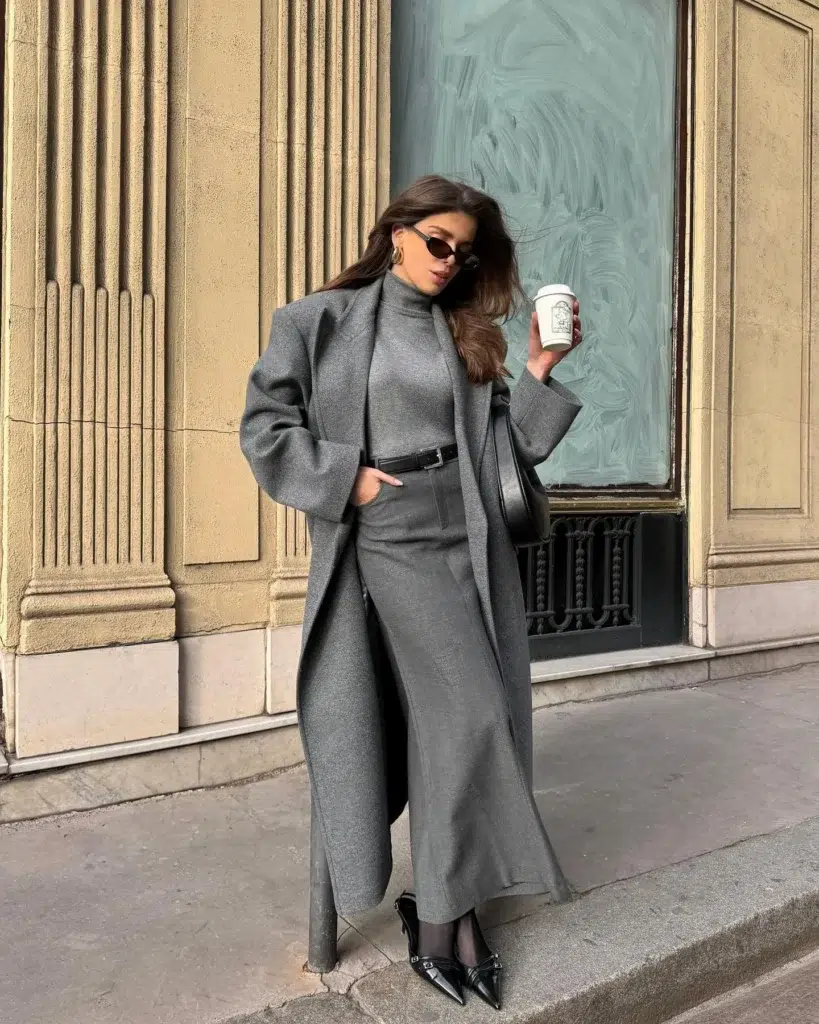
Three layers of grey stacked from turtleneck to floor-grazing coat hem, and the silhouette still reads as tall. That is not automatic. It takes precise choices at each end of the outfit to hold that much volume together.
The coat would seem like the risky element. Dramatic oversized shoulders and wide lapels can read as costume-y on a petite frame rather than polished. What makes it function here is that the coat stays open. An open longline coat frames the outfit underneath rather than enclosing it, so the eye can still find the turtleneck, the belt line, and the shoe in sequence. Close that coat, and you lose all of those landmarks, leaving only a wall of grey fabric.
The narrow black belt inside the open coat is the detail most people would style out. It quietly marks the natural waist, and even under a coat that large, that small visible anchor stops the silhouette from reading as shapeless from collar to floor.
Then there is the shoe. Patent pointed mules on a slender heel are doing more work than they appear to. With this much length and volume in every layer above, the foot needs something sharp to provide a definite ending. A chunky boot or a flat mule would let the grey simply blur into the ground. The pointed toe draws the eye forward and gives the whole column a clean, precise finish.
A longline coat worn buttoned closed over wide-leg trousers with flat or chunky footwear. The enclosed silhouette and heavy foot turn a dramatic coat into one wide shape that reads short rather than commanding.
The same coat worn open so the waist belt and layering underneath stay visible. A slim-heeled pointed mule at the foot gives the grey column a sharp, light-catching end rather than letting it blur into the pavement.
Conclusion
Monochrome dressing is one of those ideas that sounds almost too simple to work, right up until you try it and realize your morning routine just got a lot quieter. No more wondering whether the top matches the trousers or whether the shoe shade is fighting the skirt. One color family, one vertical line, done.
The real skill lives in the details this post covers: where the hem falls, what the shoe does at the foot, whether the coat stays open, how a slim belt marks the waist without interrupting the flow. Get those right and the color you choose barely matters.
html
- ▸Match shoes to the hem shade whenever possible to keep the vertical line running all the way to the floor.
- ▸Always define the waist, even lightly. One slim belt inside a monochrome outfit is the difference between a column and a shape.
- ▸Tonal does not mean identical. Two or three close shades in the same color family read more considered than one flat exact-match shade head to toe.
- ▸Keep outerwear open when the coat is longline. An open coat frames the outfit. A closed one just adds bulk.
Save this for the next time you want a put-together petite outfit without spending an hour trying to make two colors agree.